
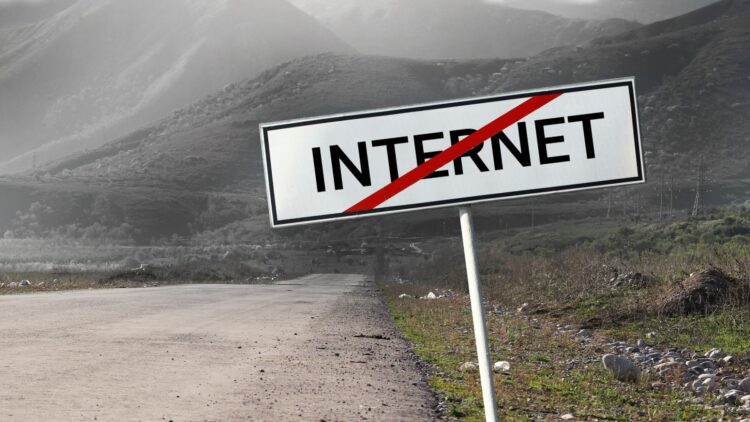
Can you imagine living again without the influence of the internet, mobile phones, social networks? It certainly sounds appealing to disconnect from the chaotic pace of life that all of this generates, to be able to focus on the present, to listen to the sea, to the birds singing, to be present with the people we love. However, this idyllic situation changes when it is imposed and has an underlying sense of control. This is what happens in North Korea, where people live in an analog way as a result of a censorship policy. Under the rule of Kim Jong Un, the country has been under the control of the family for decades, with no possibility of change.
According to the global telecommunications/ICT indicators of the International Telecommunication Union (ITU), not a single person has been reported to have used the internet from any device in the last 3 months. Internet access in the country is limited to a closed intranet, where the content is controlled and is completely isolated from the outside world. This situation creates a digital divide between the country and the rest of the planet, even for tourists visiting the country. The country often completely shuts down access for tourists, but when it does not, those who manage to access it are select. Cell service is only allowed through 3G connection, according to USA Today.
South Korea
With a population of 26.5 million inhabitants, the Democratic People’s Republic of Korea, known as North Korea, borders China to the north, Russia to the northeast, and South Korea to the south, with which it was one country until 1945. It is a sovereign state in East Asia, located in the northern part of the Korean Peninsula. Its capital is Pyongyang, and it is a dynastic totalitarian regime under the power of the Jong Un family. After the death of Kim Jong-Il in 2011, his youngest son, Kim Jong Un, came to power, maintaining the same style of governance “Juche” and “Songun”.
The economic activity of the country is based on agriculture, food industry, livestock, mining, oil, chemicals, textiles, among many others. It is no secret to anyone that the country is known for its corruption and deliberate lack of expression and opinions. There is not only control over the media but over absolutely everything that has to do with the lives of its inhabitants: clothing, job positions, haircuts, physical appearance, and more personal aspects.
Connection with the outside world
While old-fashioned dictatorships ensured that the free press, books of different genres, or voices questioning the totalitarian power system did not reach the people, current dictatorships are adapting to the current circumstances. This is the case in North Korea, which prohibits access to the internet within the country.
They have a closed intranet where the content is more than controlled, with no influence from the outside world. The limitation of connection is such that, according to the International Telecommunication Union’s (ITU) database of global telecommunications/TIC indicators, not a single person has used the internet in the last three months. How is this possible? Well, it is not a chosen analog choice, but rather imposed by the power of Kim Jong Un.
What happens with tourism?
In addition to the physical consequences that can be seen, as a result of the famine that the country has gone through for decades, National Geographic explains that “a view from space revealed that North Koreans have experienced a continuous lack of electric light across the country at night for the past few years.” The entry of tourism is subject to power; access to the country is often cut off, but when it is not, tourists who manage to enter belong to a select group. As for connectivity, foreigners are allowed to use mobile connectivity, but only through a 3G connection.
This young man lived without the internet or smartphone by his own choice and shares his experience!