
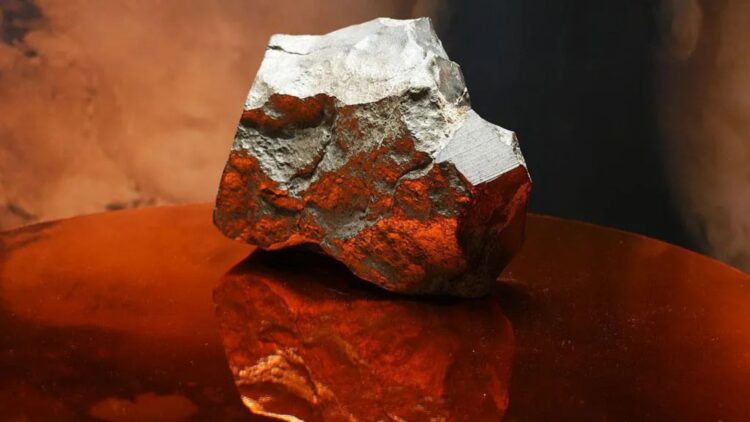
What do you think would be the impact that the rest of a meteorite from Mars would generate for science? It could be said to be incalculable, right? Well, at the moment it is not known if we will experience that scenario. I am referring to the meteorite NWA 16788 found in the Sahara desert, in Agadez, Niger, on the African continent. It is a perfectly preserved piece with hardly any damage from the earthly environment, resulting from an impact on the surface of Mars, and that flew until it landed on Earth.
The material it is composed of is 20% maskelynite, a type of natural glass resulting from extreme heat and pressure impacts. The remaining 80% is composed of pyroxene and olivine, and it has been classified as a rare Martian rock called micro-gabbro. Few specimens have reached the hands of scientists, and the fate of this one is still to be seen. After being confirmed as a Martian rock by the Shanghai Museum of Astronomy, it came into the hands of collectors and eventually ended up at Sotheby’s.
There it was auctioned for the exact amount of $5.296 million. To date, the identity of the buyer has not been revealed, so it is unknown what the fate of this Martian meteorite will be.While some scientists like the paleontologist from the University of Edinburgh, Steve Brusatte, believe that it’s a shame it will fall into private hands and should be publicly displayed, others like the planetary scientist from the University of Leicester, Julia Cartwright, argue that being in private hands will not diminish scientific interest. We will have to wait to find out if the name of its owner comes to light and what their plans are for the record-breaking Martian meteorite here on Earth.
NWA 16788, the Martian meteorite
Last year, a meteorite hunter made one of the greatest discoveries of recent times. It involves the finding of a meteorite from Mars, in the Sahara Desert, in Agadez, Nigeria, in Africa. It is the heaviest to date, weighing 25 kilos, surpassing the previous meteorite that held a record of 14.5 kilos, Taoudenni 002. It is considered an extraordinary find, as it is a fragment resulting from an impact on the surface of Mars, which has traveled through space until landing on our planet. The Shanghai Astronomy Museum confirmed that it was a Martian rock, highlighting its good state of preservation, which would provide even more information in case it is studied.
What is it made of?
The composition of this meteorite, NWA 16788, is of extreme interest to scientists, who have only been able to identify it a few times. It consists of 80% maskelynite, a natural glass resulting from extreme pressure and heat, and the remaining 20% is made up of pyroxene and olivine, which give it its granular volcanic texture.
What has happened to the meteorite?
After being examined by the Shanghai Museum of Astronomy, it ended up in the hands of collectors. Its last destination before disappearing was Sotheby’s, one of the most well-known and prestigious auction houses in the world. There, it was auctioned, expecting to fetch a figure between $2 and $4 million. However, the bids far exceeded expectations, and it was acquired for nothing less than $5.296 million.
To date, nothing is known about the buyer; neither who they are nor where the meteorite is located. The listing that defined the piece included descriptions such as ‘minimal terrestrial erosion.’ The value of this meteorite is incalculable, as experts believe it could provide information about the volcanic history of the planet Mars, as well as shed light on how planets form and separate.
What now?
As mentioned, to date nothing is known about the meteorite. Some voices like that of the paleontologist from the University of Edinburgh, Steve Brusatte, stated to CNN, “It would be a shame if it disappeared in the vault of an oligarch. It belongs in a museum, where it can be studied and enjoyed by children, families, and the general public”. Others, like the planetary scientist from the University of Leicester, Julia Cartwright, believe that “The scientific interest will remain. And the new owner may be very interested in learning from it”.
This meteorite fell into the hands of science and has changed everything that was known until now!