
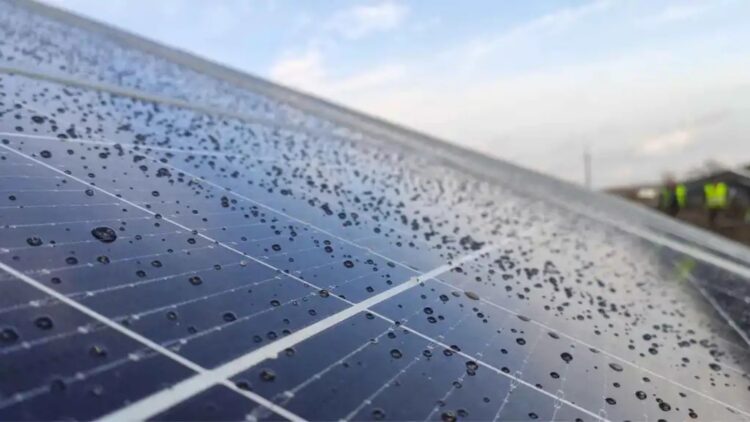
We all know about the limitations of traditional solar panels today. As their name suggests, they only work in regions where sunlight is considerable; so what happens in places where the sun barely comes out? Researchers at Soochow University in China have sought to address this problem. They are developing a hybrid panel that not only works with sunlight but also captures energy during rainy weather. This process is made possible by the incorporation of a triboelectric nanogenerator (TENG), which is capable of converting the kinetic energy of raindrops into electrical energy.
What stands out the most is its composition, as the top layer is made of polydimethylsiloxane (PDMS), a transparent polymer, and the bottom layer of PEDOT:PSS, a conductive polymer. When it rains, the drops roll across the surface of the panel, creating friction between the two polymers, generating static electricity, which is captured or converted into usable electricity. The principal investigator, Baoquan Sun, assures that the device is capable of producing energy during the day with sunlight, and with rain during the night. The prototype data reached a peak voltage of 2,147 volts and a short-circuit current of 33 nanoamperes. As published in ACS Nano, the researchers hope to have more optimized versions that provide better data.
Rain-powered solar panel
The race in which researchers and private companies are immersed is not new, with the goal of developing and optimizing a system for obtaining clean, efficient energy, without excessive costs and useful for the consumer. Wind, tidal, solar energy, and lithium batteries are the frontrunners, but there is not yet a winner. The main problem with solar panels is precisely that they would only be useful in regions where a predominantly sunny climate exists.
This is why researchers at Soochow University, under the leadership of Baoquan Sun, have launched an initiative in which an alternative to this problem is being developed. What would you say if I told you they are creating a hybrid solar panel? That’s right. A traditional solar panel but also capable of generating energy through the kinetic energy caused by raindrops.
How does it work?
The composition of this hybrid panel is the key. Researchers have incorporated a triboelectric nanogenerator (TENG) into the top layer of a standard solar cell. This top layer is made of polydimethylsiloxane (PDMS), a transparent polymer, while the lower layer contains PEDOT:PSS, another polymer, but in this case, conductive. When it rains, the drops fall on the surface of the panel, generating static electricity, which is then captured and converted into usable energy for supply.
Hibrid vs. Solar panels
The advantage of these hybrid panels is the ability to generate electricity regardless of weather conditions, whether it is day or night. Although the power obtained from hybrids does not match that obtained from traditional solar panels, researchers claim it is enough to maintain a power source without interruptions. The prototype has undergone several tests, in which it achieved the following data: a voltage peak of 2.14 volts and a short-circuit current of 33 nanoamperes. ACS Nano published the researchers’ statements, who claim that they are working on improved, more efficient, and higher-performing versions.
When can we see it in action?
According to the Soochow team, their proposal is not only innovative, but it is also a lighter, more compact, versatile design, and most importantly for companies, it comes with lower costs. For the moment, it remains a prototype and is not on sale, but the team estimates that the timeframe will not exceed 3 to 5 years. We will have to wait a few years to see if this idea truly thrives, or if along the way another innovation emerges that manages to take the lead and be the leading clean energy source for all companies.