
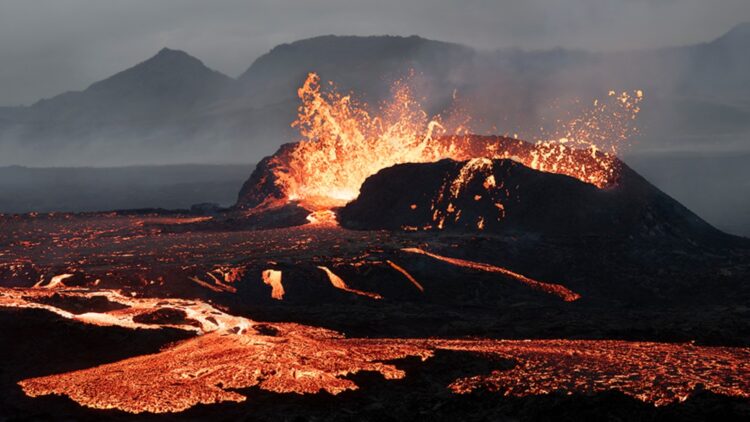
About a year and a half ago, specifically in January of the past year 2024, a volcanic eruption occurred in a fishing port in Iceland, in the city of Grindavik, southwest of the capital Reykjavik, in Iceland. This island is located between the Mid-Atlantic Ridge, in the oceanic ridge that separates the tectonic plates of Eurasia and North America. It was one of the most violent eruptions, which is part of what is expected to be a new episode of tectonic plate separation, as explained by Patrick Alard, a volcanologist at the Institut de Physique du Globe in Paris.
This new wave of volcanic eruptions began in 2021, when experts noticed that the ground was distorting and magma was rising from the depths, entering an area 3-10 kilometers below the surface, as Allard explained. Although large amounts of magma were not expected from the eruptions, the geothermal plant of Svartsengi, located nearby and supplying electricity to the Reykjanes peninsula, was indeed a concern.
The geothermal spas of the Blue Lagoon were forced to close due to the eruptions, in order to protect visitors. Back in 2010, the Eyjafjallajökull volcano released such a large amount of ash into the atmosphere that 100,000 flights were canceled, leaving travelers stranded and causing global chaos. Experts do not believe that an event of this nature will occur in the Reykjanes peninsula, but any precaution is always warranted.
Grindavik
Grindavik is a municipality located on the Reykjanes peninsula, on the southwest coast of Iceland, west of the country’s capital, Reykjavik. It has its own port on its coast, so it is logical that almost its entire population is dedicated to the fishing industry. With a population of approximately 3,579 inhabitants, it is a city built 800 years ago, and it is suspected to be right on top of another city that had already been buried by lava from a volcanic eruption.
2024 eruptions
In January 2024, volcanic eruptions occurred that buried several houses in the village. Experts warn that the port is located over an oceanic ridge that is threatening to erupt in the coming years. They also reported that the island is situated right on the Mario Rift at the bottom, which separates the tectonic plates of Eurasia and North America; the Mid-Atlantic Ridge. According to Patrick Allard, the volcanologist from the Institute of Physics of the Globe in Paris, “After eight centuries of relative quiescence and a complete cessation of surface activity, we have entered a new episode of plate separation that could last several years – possibly decades”.
This wave of eruptions had already begun three years earlier, in 2021, when according to Allard, scientists “observed that the ground was distorting, with magma rising from the depths and penetrating into” an area of three to 10 kilometers (two to six miles) below the surface”.
What happened next?
The last two eruptions in January were described by Allard as “brief and preceded by very little seismic activity.” According to the volcanologist, the thinness of the Earth’s crust near the fault line under Iceland will help trigger these “pressure releases” of magma. However, the amount that will actually explode to the Earth’s surface is not expected to be huge. Although excessively destructive eruptions were not anticipated, there was concern for the Svartsengi geothermal plant located nearby, which supplies energy to the 30,000 residents of the Reykjanes peninsula.
Additionally, as a precaution, they also decided to close public access to the Blue Lagoon, known for its geothermal spas and great tourist attraction. Allard stated, “there will probably be little warning before the next eruption. During the last two eruptions, there were only ‘a few hours of critical seismic activity’ to warn that the magma was rapidly rising to the surface. There was also the risk of a submarine eruption, which could create an ‘explosive phenomenon, releasing more volcanic ash”.
This reminded one of the case of the Eyjafjallajökull volcano, which in 2012 emitted such a volume of ash into the atmosphere that over 10 million travelers were stranded, and more than 100,000 flights were canceled. Nevertheless, experts and volcanologists believed that the chances of such an event occurring on the Reykjanes Peninsula were considerably low.
These mysterious structures beneath the Earth are behind the planet’s most devastating eruptions!