
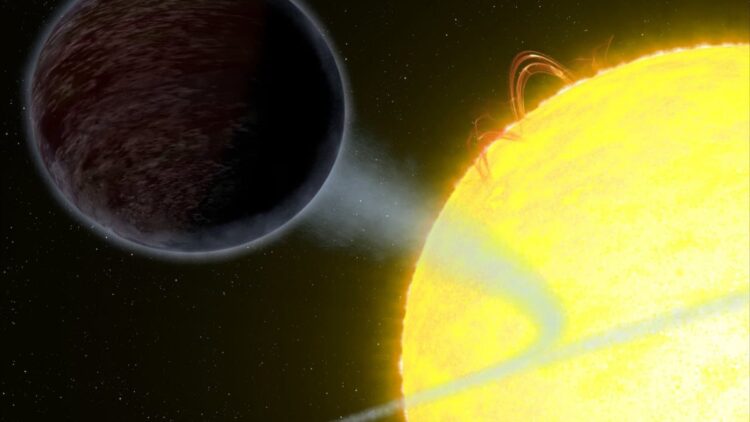
In this moment, space scientists must be revising their notes and favorite books, as they can’t believe what they are observing. Apparently, a giant exoplanet named WASP-12b, located about 1,400 light-years away in the constellation Auriga, is behaving abnormally. It appears to be approaching its host star at high speed and may be consuming itself.
One of the researchers from the Harvard-Smithsonian Centre for Astrophysics, Shreyas Vissapragada, stated that, although there are several theories about what is happening, none is conclusive. This event also suggests that it could be a behavior mimicked by the Earth, which could be engulfed by the Sun’s expansion. So far no conclusions have been reached, but it is an event that serves to expand knowledge and perhaps predict the future of our planet.
WASP-12b
The protagonist of this puzzling event is a gas giant exoplanet, known as hot Jupiter. It orbits the star WASP-12, from which it gets its name. It is 870 light-years from Earth, and about 1,400 light-years away in the constellation Auriga. Given its erratic behavior, scientists have dubbed it the planet with “a death wish”. Contrary to the behavior of all other planets in relation to their star, WASP-12b draws an inner spiral toward its star, which would result in its consumption in a few million years. It also belongs to a series of planets that orbit very close to its star.
They are characterized by their high temperatures; in this case 4,000 degrees Fahrenheit (more than 2,200 ºC), and it has been recorded that it completes an orbit in a little more than 24 hours.Scientists not only want to find out why it behaves this way, but they are also alarmed by the speed at which it is approaching the star. According to them, a process that should take billions of years is occurring at a rate of 29 milliseconds per year, which reduces the time frame to millions of years.
Does this represent a paradigm shift?
Everything that was known so far about orbital mechanics is being questioned by scientists in the face of this discovery. It is a planet that orbits in a totally opposite way to what were now the rules of the universe. Several scientists have spoken out about it. In the case of Shreyas Vissapragada, a researcher at the Harvard-Smithsonian Centre for Astrophysics, he has stated that some theories are being considered, but that at the moment none of them is valid because they are not conclusive.
One of the most popular theories is the effect of tidal interactions. It is believed that the gravitational attraction between the planet and its star is causing the orbital energy of WASP-12b to drain away, moving closer and closer to the center of its star, which is a destructive outcome. The problem, according to scientists, is that this approach is occurring much faster than it should. The experts could justify this displacement with the star’s gravity.
They believe that this could be the cause of the distortion of the planet’s trajectory, causing internal friction and heat, which is accelerating its global disintegration. However, they have not found a way to explain the velocity. Vissapragada stated “The star would have to dissipate the orbital energy much more efficiently than we thought possible”.
Is this the destiny of our solar system?
Despite the unusual behavior, experts believe that this event could be a mirror of what the earth will experience a billion years from now. As the Sun expands into a red giant, it is expected that Mercury, Venus and the Earth will eventually be engulfed by it. While scientists search for an explanation of what is happening, space is giving us another moment of learning and new experiences.