
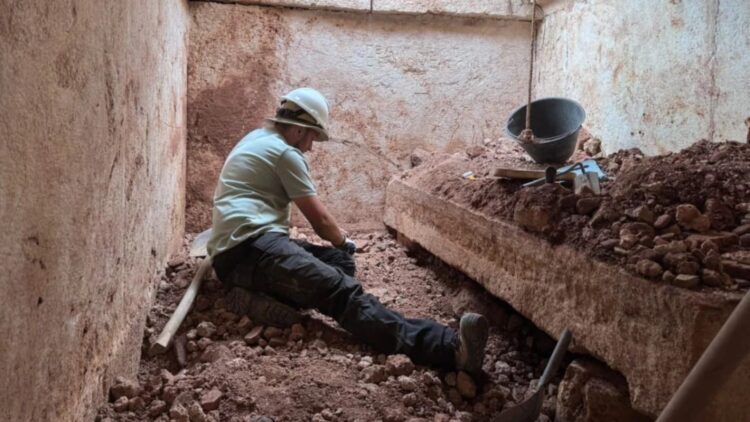
Located in northeastern Albania, the village of Strikçan, in the Bulqizë region, has been the scene of an unprecedented discovery. It involves the discovery of a large mausoleum with complex architecture, bilingual inscriptions, and grave goods that have been linked to a Roman elite. One of the most important finds in the country in recent decades, it has been announced by the Albanian Institute of Archaeology.
After residents of Strikçan reported what appeared to be a strange formation of stones, it turned out to be one of the most significant finds, discovered by a team from the Institute of Archaeology and supported by the National Institute of Cultural Heritage. Upon discovery, archaeologists had no doubt: it was a mausoleum typical of the burial style of high-status individuals in the Roman Empire. Although the find itself is the first of its kind in the Dibra region, what attracted the most attention were the inscriptions dedicated to Jupiter, the supreme god of the Roman pantheon.
It should also be noted that, for centuries, Albania was part of the ancient Roman province of Illyricum, and although the Roman presence in the area was known, no discovery of this nature had ever been made. That is why, although Albania already has Roman sites protected under UNESCO World Heritage status, such as the site of Butrint, this tomb adds interest and reinforces the diversity of Albanian heritage.
New findings in Albania
The village of Strikçan, in the Bulqizë region of Albania, has been the site of one of the most significant discoveries in the country in recent decades. The discovery is that of a tomb, specifically a mausoleum, featuring complex architecture with bilingual inscriptions and funerary objects typical of the Roman elite. What was initially a strange formation of stones that caught the attention of local residents ended up being the reason why the Albanian Institute of Archaeology, supported by the National Institute of Cultural Heritage, launched an excavation in the area.
Roman mausoleum
Archaeologists had no doubt: it was a mausoleum characteristic of the Roman Empire, reserved for people of high status. A tomb 9 meters long, 6 meters wide, with an antechamber and a burial chamber 2.5 meters high. In addition to its large size, archaeologists were struck by the Greek inscriptions with Latin content, which read “Gelliano.” The inscriptions were also dedicated to Jupiter, the supreme god of the Roman pantheon, suggesting that the person buried there held a prominent position in society and also had religious or spiritual ties.
Findings inside the tomb
Archaeologists observed that the tomb had been looted twice: once in ancient times and again more recently, with heavy machinery being used. However, they were able to recover valuable objects such as glass plates, knives, bone utensils, and fragments of fabric embroidered with gold thread. It was this last discovery that confirmed that the person buried there either belonged to a Roman aristocratic family or was part of the local administration.
What does this discovery imply?
It has been known for years that Albania belonged to the ancient Roman province of Illyricum, along with what is now Croatia, Bosnia-Herzegovina, and Montenegro. However, this type of discovery is the first of its kind, which challenges what was previously understood about the integration of the elite in the Roman world. Furthermore, this is not the first Roman site in the country: Butrint has been declared a UNESCO World Heritage Site. However, the findings at this site are unique, enriching the diversity of Albania’s Roman heritage.