
An 8-year-old boy who was playing in a forest near the University of Pennsylvania did not know that he was about to make a discovery that would completely change the understanding of certain aspects related to science. The boy, Hugo Deans, picked up what he thought were tree seeds, and when he showed them to his father, entomology professor Andrew Deans, he identified them as oak galls. This discovery led to a study that has been able to redefine interactions between plants and insects, which was published in the journal American Naturalist.
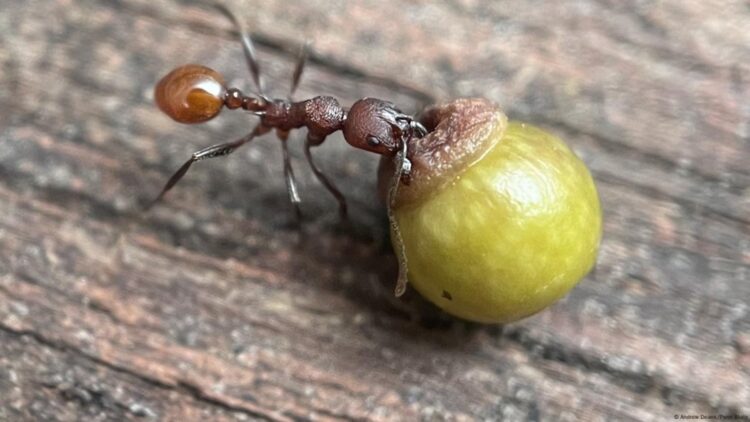
As explained by Antropocene, myrmecochory is the mechanism through which some angiosperms ensure that their seeds are transported and dispersed thanks to ants. The researchers placed cameras in ant colonies and set out galls with and without caps, capturing how the ants quickly transported the capped ones, thinking they were seeds, while ignoring those without caps. In this way, they were able to confirm the hypothesis that there is a direct relationship between the presence of fatty compounds and the ants’ choice of what to transport.
Discovery in Pennsylvania
Little Hugo Deans didn’t know he was about to make one of the greatest discoveries in entomology while quietly playing in the forest. He found what looked like tree seeds, and when he showed them to his father, he couldn’t believe his eyes. Andrew Deans, his father, is a professor of entomology, and he quickly realized that these were not seeds, but oak galls. Galls of what? Oak galls. These are formations that occur when an insect induces a tree to produce plant tissue in which to deposit its larvae. The discovery was so significant that a study was conducted and published in the pages of the journal American Naturalist.
Myrmecochory
It is important to have this concept clear in order to understand the rest of the study. According to Antropocene, “Myrmecochory is the mechanism through which some angiosperms manage for their seeds to be transported and dispersed by ants. These insects have a remarkable ability to carry seeds and fruits over long distances, which gives rise to a particular symbiosis with certain plant species. The process occurs when the worker ants collect the diaspores and take them to the colony, where they consume the elaiosome to feed the larvae, while the seed, now without the appendage, is deposited in underground chambers with organic remains or ejected from the nest, thereby favoring its dispersal and subsequent germination”.
Smart wasps
A clear example that nature will never stop giving us lessons, this study has shown how wasps not only lay their eggs in oaks, but also inject a chemical compound that alters the development of that plant tissue, tricking the tree into making a nutritious and protective capsule that will house the wasp embryo. Up to this point, there would be nothing “new.”
What happens next is what has drawn attention: some galls develop a fleshy cap that is attractive to ants. It is made up of fatty acids that serve as food for the ants, so they collect them as if they were seeds, taking them to their nests, and without realizing it, they are acting as guardians of the wasps.
How did they test this theory?
The researchers decided to place cameras in different ant colony environments to capture their behavior. The images demonstrated what had been proposed in the hypothesis: the ants prioritized choosing capped galls, treating them as if they were seeds with elaiosomes, while those without caps were completely ignored. According to Andrew Deans in an interview, ‘What impressed me most was realizing that I had spent years studying insects without noticing this relationship.’ Father and son never imagined that an afternoon playing in the forest could lead to one of the greatest entomological revelations to date.