
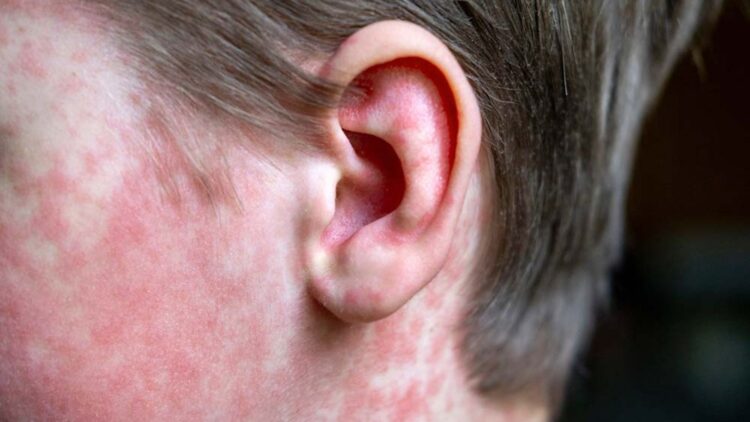
The South Carolina Department of Public Health, together with epidemiologist Linda Bell, has announced a measles outbreak in the northern part of the state of South Carolina, which has put the entire state on alert. This epidemic outbreak could originate from cases due to international travel, while the causes of others are unknown. The number of cases in the United States has reached 1,500, which represents an unprecedented spread, according to Bell.
The percentage required to achieve herd immunity is 95%, whereas the rate in South Carolina is 90%. For this reason, Bell advises vaccination for those who have not yet been vaccinated. According to the Centers for Disease Control and Prevention (CDC), measles symptoms usually appear within 7 to 14 days, including high fever, cough, or runny nose.
Measles
Measles is considered a febrile, contagious, and even epidemic disease. Although it is more common in children, it can affect anyone, without discrimination, and spreads easily when an infected person coughs, sneezes, or breathes. It manifests as numerous small red spots, similar to flea bites, and is preceded and accompanied by tearing, sneezing, coughing, and other cold-like symptoms, which appear within 7 to 14 days. There is no specific treatment for it, only attempts to relieve the symptoms once it has been contracted. The only way to prevent it is through the immunity provided by the vaccine.
Epidemiological Outbreak
in South CarolinaAlarm bells have recently been raised in the northern part of South Carolina following an announcement by the South Carolina Department of Public Health and epidemiologist Linda Bell. A measles outbreak has been declared in the northern part of the state, with eight confirmed cases and five suspected cases linked to a school. According to state officials, “A minimum of three connected cases is considered the threshold for an outbreak,” and Bell stated that “our level of concern is for the entire state”.
Where do the infections come from?
The recording of cases in the United States has reached a level not seen in approximately 30 years: 1,500 measles cases across the country. Of the detected cases, it is believed that three of them, two in July and one in September, were caused by international travel, while another infection occurred within South Carolina. The sources of two other cases are unknown. According to epidemiologist Bell, “We just want people to recognize how highly transmissible this virus is, and that it doesn’t matter which region you live in. We are seeing unrecognized spread in the state”.
Spread and infections
While experts say that the total coverage rate needed to prevent measles transmission and outbreaks is 95%, South Carolina’s vaccination rate is estimated at 90%. It is the same percentage of infection for people who are not vaccinated and are exposed to the virus.
What symptoms can be experienced? For how long?
Data from the Centers for Disease Control and Prevention (CDC) reveal that symptoms can appear between 7 and 14 days, depending on the case. These symptoms include high fever, cough, nasal discharge, and watery eyes. Two or three days after the onset of symptoms, small white spots may appear inside the mouth of the infected person, and between three and five days later, the measles rash appears.
What begins as red spots along the hairline and around the face spreads throughout the body. It is a virus that can affect anyone, regardless of age. However, it is more likely to thrive in people with weaker immune systems, in young children, and in pregnant women. Additionally, both the latter and people with autoimmune conditions cannot be vaccinated, making their exposure even more dangerous.