
Everything related to science has as its main motivation the desire to be the first to discover or be able to explain it. The same happens in other sectors: if we think about it, companies strive to be the first to launch a particular product, and scientists want to be the first to provide answers to unanswered questions. In the case at hand, it was Russia that was the first to send a satellite into space containing various special animals, which, despite being called the Bion-M No.2 satellite, has been nicknamed Noah’s Ark. It was launched from Baikonur on August 20, and after 30 days in orbit, it landed in the city of Orenburg on September 19.
The space module contained mice, flies, and other microorganisms and fungi that were exposed to radiation, being monitored at all times. Now that they have returned, it is estimated that the results could take up to two years to obtain, but the Biomedical Institute has considered the option of using artificial intelligence to speed up the process. What began in 1973 with the Soviet Union and the Bion satellites was resumed in 2013 with the launch of Bion-1, and now with Bion-2.
Technology race
Any company, regardless of the sector, wants to be a pioneer, the fastest, the best prepared, and the first to respond to users’ needs or to questions that are yet to be answered. In this case, we will focus on the space race, specifically on the launch of animals into space. This time it has been Russia that has taken the lead, although the results of the mission are still pending.
Noah’s Ark
On August 20, it was launched from the city of Baikonur, where what is considered the largest and oldest space base in the world is located, a Russian satellite whose mission lasted 30 days, and whose name is Bion-M No.2. On September 19, the satellite, also nicknamed Noah’s Ark, landed in the city of Orenburg after completing its mission.
What was inside the satellite?
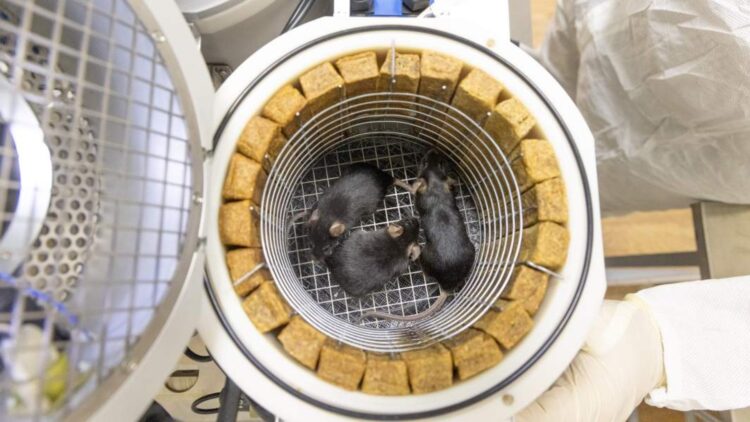
The satellite had a most unexpected crew: a total of 75 mice, more than 1,000 flies, microorganisms, and fungi were the protagonists of this mission. During the 30 days it was in orbit, the satellite was exposed to high radiation, which was monitored and photographed by scientists on Earth. Some of the mice were fed dry food, while the vast majority were given paste. They also had sensors through which scientists could measure both radiation and temperature, in order to keep them under control at all times.
What happens now that the satellite has completed its mission?
With the satellite’s return to Earth, it is now time to analyze the data obtained. Scientists explain that it will not be an easy task, as they have thousands of hours of recordings that are yet to be analyzed, from which they hope to extract the relevant conclusions. It is estimated that the waiting time to know the results is more than two years! This is why the Biomedical Institute is considering the possibility of using artificial intelligence to accelerate the process and obtain the results before the estimated time.
Where does this mission come from?
It was in 1973 when the Soviet Union created a series of satellites under the name Bion, but it wasn’t until 2013 that the first one, Bion-1, was launched, and now, in 2025, the second one, Bion-2, was launched.