
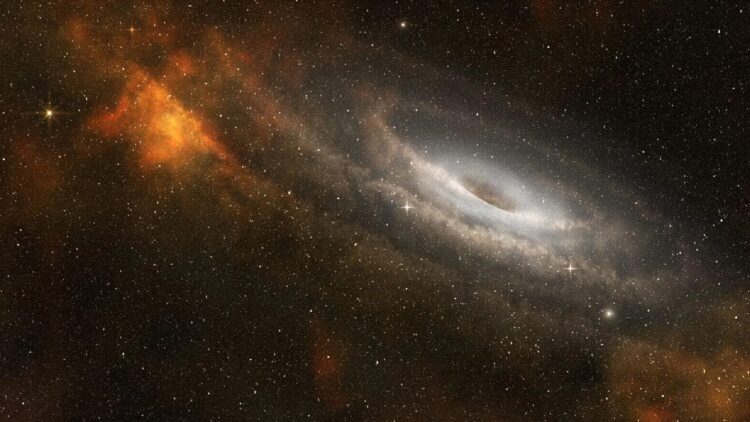
All the information about space that we have comes from research carried out by international agencies such as NASA or ESA. There are more events that need to be studied and that occur than the resources and time that agencies have to study them. That is why those that do not show interest are discarded in search of more significant ones. However, one of the discarded phenomena ended up becoming one of the most studied phenomena. This is the case of the galaxy PBC J2333.9-2343, which was initially considered a radio galaxy with radial lobes. After no movement was detected in its core, it was considered inactive.
However, thanks to the wavelength probes deep within the galaxy, scientists have been able to see that one of its jets points almost directly at Earth. They have now been able to redefine this phenomenon as a blazar, that is, an active galactic nucleus (AGN). Space observatories cannot focus on all the phenomena occurring in space, but in this case, they missed the cosmic identity change of this black hole for not having continuous monitoring. What could have been a real-time betrayal has turned into a reconstruction of what happened afterwards.
Space observatories
The National Aeronautics and Space Administration (NASA) or the European Space Agency (ESA) are just some of the most important space observatories, responsible for transferring all the information they gather and analyze to the knowledge of the rest of society. Everything we know when we look at the sky comes from them. Advances in science and technology have made these tasks easier, but the truth is that they cannot pay attention to every event, so if they are not of interest, they end up being discarded or relegated to the background.
PBC J2333.9-2343
Something similar happened with the discovery of a galaxy whose trajectory seemed to deviate from Earth’s orbit. After its observation and analysis, it was considered a radio galaxy with radial lobes spanning millions of light-years. When they analyzed its nucleus, which was the most striking part of the discovery, they did not detect any movement, so they considered it inactive. Spoiler: it was not. Thanks to the increase in wavelength probes deep within its nucleus, it has been possible to discover that one of its jets almost points directly at Earth.
Blazar or radio galaxy?
To understand what happened with PBC J2333.9-2343, let’s first define the concepts. A blazar is an active galactic nucleus (AGN) with a relativistic jet pointed very close to an observer, while a radio galaxy is a galaxy with giant radio-emission regions that extend far beyond its visible structure. Considering these concepts, the features of PBC J2333.9-2343 are very similar to those of a blazar.
Has NASA made an observation error?
As we have mentioned, it is unfeasible for space observatories to monitor all the phenomena in space, so they have to discard them according to their importance. However, it is true that if continuous monitoring of this galaxy had been maintained, it would have been possible to capture the transition of this phenomenon in real time, thus allowing a deeper study of the behavior of black holes.
Furthermore, this type of event also suggests that other events that were defined and categorized a long time ago may have now changed, or a deeper analysis of them may be possible, discovering relics as has happened with PBC J2333.9-2343.