
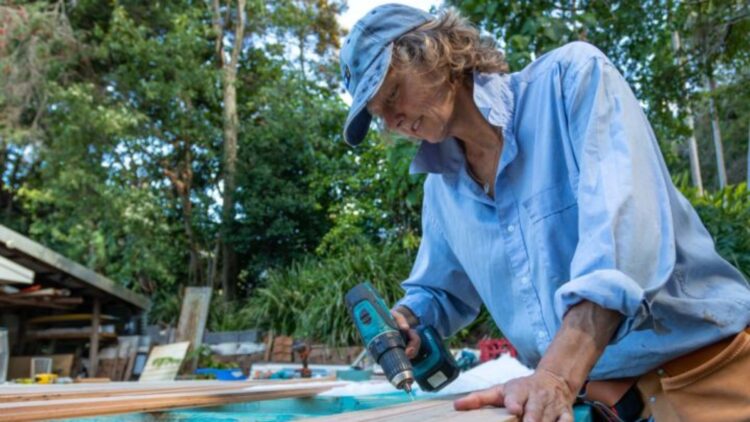
The story of Louise Southerden began when she was 48 years old and, after moving to Sydney, in northern New South Wales, Australia, in search of cheaper rentals, she realized that she longed for her own home and not having to pay exorbitant rents caused by the housing crisis. Upon turning 50, she decided to simplify her life to a more minimalist lifestyle, opting to build a tiny house.
The COVID-19 pandemic allowed her to get to work, and with the help of people around her, she began construction in September 2020. The house was completed in May 2021, and finally, at 56, she was able to move into her own home. Southerden is delighted with this type of sustainable and self-sufficient living, based on handcrafted construction and eco-friendly design.
Louise Southerden´s story
For 25 years, travel writer Louise Southerden packed her life into a backpack and traveled the world with just the essentials, basing herself in Sydney. When she turned 48, she faced Sydney’s housing crisis and moved north in New South Wales in search of cheaper rentals, but the situation there was even worse. Upon turning 50, she decided that since she couldn’t afford to pay rent on her own, she would opt for a small house. Her idea was something small, a minimalist life she was accustomed to because of her work. She became interested in sustainable architecture, specifically straw bale houses, but for that, she needed land to build on, which cost money she didn’t have.
Tiny house movement
The solution came when they discovered tiny houses on wheels, which met all their needs and fit within their budget.Houses that are cheap to build and economical (both in construction and maintenance).It is not necessary to own land, as it was enough to pay a small rent or fee to park it on someone else’s land.They could lead a minimalist and sustainable lifestyle.In Australia, a specific building code was not required for them, so even someone without experience could build one.
Hands on During COVID-19
For Southerden, the pandemic was the boost she needed. Unable to work due to border closures and receiving a wage subsidy from the government, she decided it was time to get hands-on. Although she had neither experience nor the slightest idea of how to do it, that did not stop her; instead, it motivated her even more toward an adventure she saw as a personal challenge.
Construction Process
To compensate for her lack of knowledge in the field, she decided to read about architecture in small spaces and take a tiny house construction workshop. She also had the help of her then-partner, Max, whom she describes as a “talented carpenter.” Both renovations and the construction work (and apparently tiny house building) add extra stress for couples and can be decisive. In the case of Louise and Max, it was, although they managed to continue working together to finish the project.
New happiness
End of the projectIn May 2021, the writer was able to enter her home for the first time, now completed. Measuring 7 meters long by 2.4 meters wide (23 feet by 8 feet), she opted for a minimalist, self-sufficient, and eco-friendly design. She defined her new state of happiness and peace as “anchoring in a calm bay after being dragged through an endless storm”.
The lack of legislation regarding tiny houses in Australia allows her to pay a weekly rent less than half of what she paid before. She has no debts and now has more time to engage in activities such as walking, volunteering in the community garden, and even has more time to write. She does not regret her decision at all and cannot imagine living any other way.