
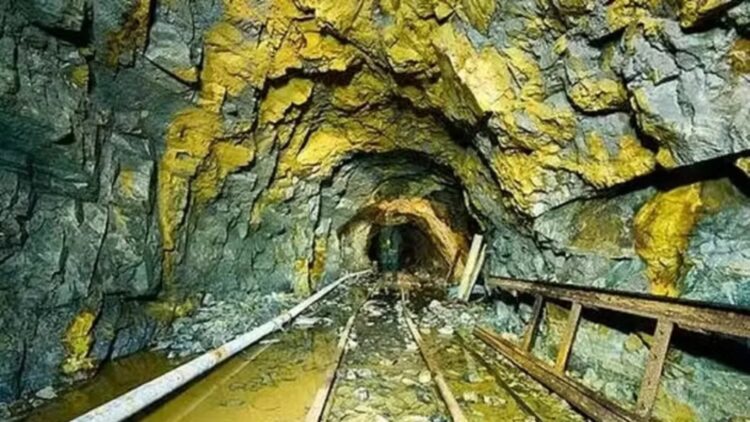
China has announced the discovery of a massive gold deposit in the Wangu goldfield, located in Hunan Province, which could exceed 1,000 metric tons. This find, valued at about 600 billion yuan, is a milestone for China’s mineral resources and has been confirmed by the Hunan Geological Bureau and the Hunan Provincial Institute of Geology. Geologist Chen Rulin highlighted the presence of visible gold in the cores.
The complexity of gold mining lies in the fact that the veins are located 2,000 meters deep. Success will depend on whether the ore grade justifies the high extraction costs, a challenge comparable to deep deposits such as the South Deep Mine. Geologically, the deposit is favorable, located in the Jiangnan orogen, a region that already hosts the Huangjindong deposit and is associated with Mesozoic granite structures, typical of orogenic gold. The USGS and other experts will observe whether the reserves are continuous and profitable.
New gold mine in China
China has announced the discovery of an underground treasure after finding a deposit with more than 1,000 metric tons of gold in Wangu, Hunan Province. The fieldwork and reports have been conducted by the Hunan Geological Office and the Hunan Provincial Institute of Geology. It is estimated that this gold field is worth 600 billion yuan, but much work remains to be done. The announcement includes more than 40 gold veins at depths of around 2,000 meters, approximately 6,560 feet, with models projecting mineralization down to 3,000 meters, approximately 9,840 feet. These figures are initial estimates, and the actual feasibility will need to be determined.
Mineral grade
To understand the importance of this finding, it is important to understand the definition of ‘mineral grade.’ By definition, the mineral grade is the concentration of gold in the rock, and g/t means grams of gold per metric ton of ore. Higher averages generally indicate more efficient mining and less waste rock per ounce produced. For comparison, the South Deep mine in South Africa has approximately 27.998 million ounces of proven and probable reserves, about 870 tons.
How was the project carried out?
Fieldwork required records of tens of thousands of feet of core, heaves, and 3D model structures to track where the veins were heading. According to a mineral prospecting expert with the Hunan Provincial Geological Office, Chen Rulin, “Many drilled rock cores showed visible gold.” Additionally, he also observed that in a single interval, nearly 138 g/t was recorded over a range of 2,000 meters, which may indicate two opposite poles: either it suggests that the system is fertile, or it does not describe the average grade across the mineral body.
When does a deposit become a mine?
For a deposit to become a mine, factors such as average grade, continuity, and thickness must be considered. For this reason, engineers look for areas that are thick enough, consistent, and close to existing infrastructure to justify the cost of ventilation shafts, necessary energy, and water management. The depth of a deposit implies increased costs, which is why continuity and grade are also important considerations.
The cutoff grade is the minimum grade that mining is willing to pay, which can increase as costs rise. Margins account for the rising costs of energy, labor, ground support, and dewatering, but if exceeded, the mining plan changes and focuses only on the richer zones, ignoring the rest.
Why is this area a favorable region?
The Wangu Deposit is located in the Jiangnan orogenic belt, an area of crustal collisions and fractures. It is a region where more than 315 tons had already been estimated before this announcement, making it the most important area in the Jiangnan belt. Moreover, mineral studies show the presence of quartz veins, altered clays, and breccias, along with common wall rock alterations such as sericitization and carbonation.