
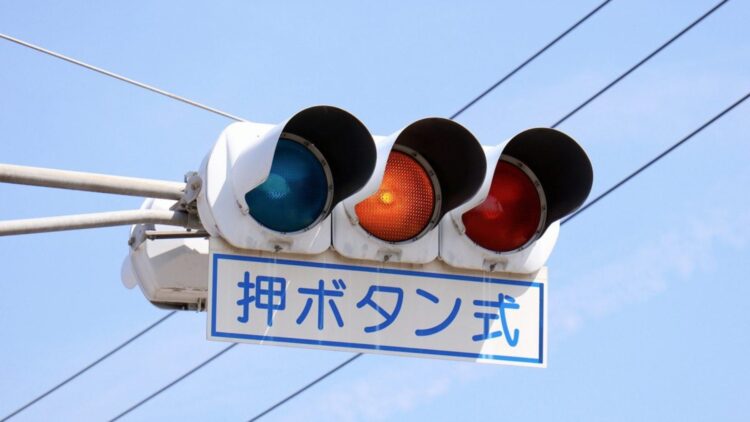
The idea that traffic light colors are green, amber, and red is part of the collective imaginary, and it is something we take for granted almost universally. Red tells us to stop, amber tells us to adjust our speed, and green tells us we can keep going. This has been the case worldwide since 1968, except in one country where cultural and linguistic differences have challenged this belief. That country is Japan, where the color green does not mean go, but rather it is the color blue.
This is perfectly explained by Japanese professor Ito, who says that in ancient Japanese there were only four color names: red, black, white, and blue. To refer to the rest of the colors, including what we now call green, the term ao (青) was used. Although the first traffic lights with green lights appeared after World War II, the Road Traffic Act described the traffic light as ‘ao,’ which has persisted to this day.That is why, although the actual color of the light is still mainly green, there are some areas where the lights appear more blue.
Do you know when the first traffic light was installed?
As they are part of our daily lives on the roads, we hardly ever stop to think about when the first traffic light was installed. The truth is that we have to go back to the mid-19th century, when a gas-powered traffic light was first seen in London. However, it was not very successful, as it exploded a few weeks after its installation. The first electric traffic lights appeared in America in 1912 and were operated manually with red and green lights.
Later, the color yellow or amber was introduced to help transition from driving to stopping in a more subtle way. In the 1950s, traffic lights were automated in the United States and then standardized throughout the rest of the world, thanks to the Vienna Convention on Road Traffic in 1968. It is worth noting that the United States did not sign this treaty, but the red, yellow, and green traffic lights were adopted by the country.
Traffic lights in Japan
Although traffic light signals have been adopted almost universally around the world, Japan has not been able to avoid cultural and linguistic differences in this regard. It is important to understand that while in most other countries the color green is usually associated with terms like ‘open road,’ ‘available,’ ‘go,’ in Japan, this is not the case. In fact, the color that encompasses all these characteristics is blue.
Japanese professor Ito perfectly explains the origin of this difference: ‘In ancient Japanese, there were only four color names: red, black, white, and blue. The term ao (青) was used to refer to a wide range of colors, including what we now call green. When traffic lights were first introduced in Japan [in the 1930s], the green light was sometimes called green, just as in other countries. However, after the Second World War, the Road Traffic Act [of 1960] described the traffic light as ‘ao,’ and it has been referred to that way ever since”.
That is why it is characterized by its progressive spirit and futuristic ideas. However, this aspect is essentially characterized by maintaining a linguistic phenomenon leftover from ancient Japanese, although the actual color of the light corresponding to green still remains green in traffic lights in Japan (despite not having signed the Vienna Convention), there are some areas where the lights have bluer shades, especially noticeable to tourists.