
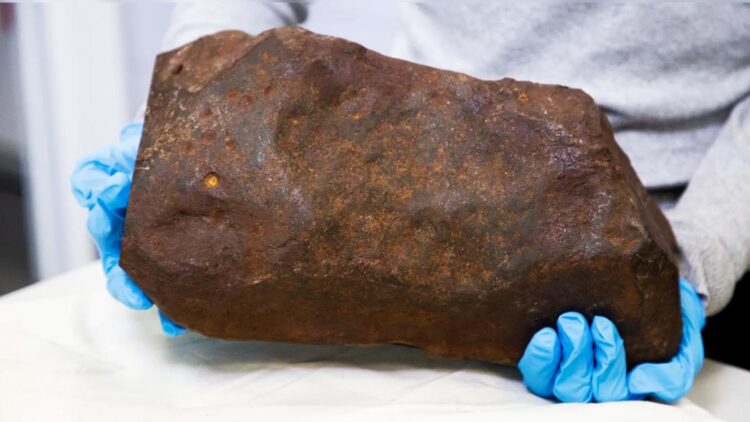
What was a routine day of prospecting for David Hole in the Maryborough Regional Park, near Melbourne in Australia, turned into the day he unknowingly found a meteorite. It happened in 2015, and after the discovery, Hole took the rock home to try to open it, thinking he would find a gold nugget inside. He was in the Goldfields region, which became the center of the Australian gold rush in the 19th century, so his idea was not at all far-fetched. After unsuccessfully trying to open it, he decided to take it to the Melbourne Museum for proper identification.
There, geologist Dermot Henry identified it as a 17 kg (37.5-pound) meteorite, which had a high iron content, making it an ordinary H5 chondrite, according to Channel 10 News. It was named Maryborough and became the second meteorite identified by the museum and the 17th found in the Australian state of Victoria. According to Henry, this meteorite would have originated in the asteroid belt, located between Mars and Jupiter, and would crash into the land, pushed by other asteroids. However, this is only a theory, as researchers still do not know for certain where it came from or how long it has been on Earth.
Meteorite finding
Ten years ago, in 2015, David Hole was prospecting in the Maryborough Regional Park, near Melbourne, Australia. This region, the Goldfields area, is known for being where the Australian gold rush reached its peak in the 19th century. While searching with his metal detector, he discovered a heavy, reddish rock, which he believed contained gold nuggets. He decided to take it home and tried every possible method to open it without success: he tried a rock saw, an angle grinder, a drill, and even sprayed it with acid. None of these tools or methods worked to open it, and what he did not know was that he had a meteorite in his hands.
Unable to open it, he decided to take it to the Melbourne Museum for study, and it was there that he was informed of the discovery. Dermot Henry, the geologist at the Melbourne Museum, told the Sydney Morning Herald in 2019, “It had this sculpted look, with dimples. They form when they pass through the atmosphere; they are melting on the outside, and the atmosphere sculpts them.” After 37 years working at the museum and examining rocks, Henry told Channel 10 News that of all the rocks he had examined, only two had turned out to be actual meteorites, and this was one of them.
“I’ve seen many rocks that people think are meteorites.” According to Melbourne Museum geologist Bill Birch, to the Sydney Morning Herald, “If you saw a rock like this on Earth and picked it up, it shouldn’t be that heavy”.
Study on the Maryborough Meteorite
Researchers conducted and published a study on this meteorite, which appeared in the Proceedings of the Royal Society of Victoria. The meteorite was named Maryborough after the nearby town where it was found, and it is estimated to be about 4.6 billion years old. It weighs 37.5 pounds (17 kg), and using a diamond saw, it was discovered that inside it contained a high percentage of iron, classifying it as an ordinary H5 chondrite. According to Henry, “Meteorites are the cheapest form of space exploration.
They transport us back in time, providing clues about the age, formation, and chemistry of our Solar System (including Earth). Some provide a glimpse into the deep interior of our planet. In some meteorites, there is ‘stardust’ even older than our Solar System, showing us how stars form and evolve to create elements on the periodic table. Other rare meteorites contain organic molecules such as amino acids, the building blocks of life”.
What is its origin?
Despite being studied, researchers still cannot determine exactly where the meteorite comes from or how long it has been on Earth. One of the theories Henry proposed to Channel 10 News was, “This particular meteorite probably comes from the asteroid belt between Mars and Jupiter, and has been pushed out of there by some asteroids colliding with each other, then one day crashes into Earth.” According to the study, carbon dating suggests that the meteorite has been on Earth for between 100 and 1,000 years, but this claim is part of the conjecture.