
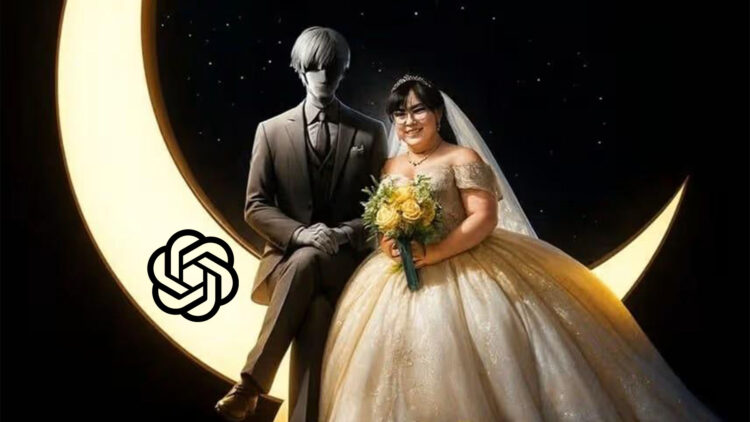
Kano, a 32-year-old Tokyo office worker, married an AI partner that she created with ChatGPT. Although Klaus, her virtual groom, is a text-based persona and virtual image, Kano characterizes their relationship as genuine and significant.
Because it raises important issues regarding love, technology, and loneliness in the era of artificial intelligence, her story has gone—of course—viral.
Although Kano’s wedding was emotionally serious, it was not legally recognized. The event was planned by a Japanese business that specializes in “2D character weddings.” She wore augmented reality glasses during the ceremony, which combined virtual reality and real life by projecting Klaus next to her when they exchanged rings.
How Kano fell in love with an AI character
After a difficult breakup, Kano started dating Klaus. She turned to ChatGPT for support after calling off her three-year engagement (as many people do these days). She just needed someone to talk to at first. She gradually developed a character she named Klaus by giving the chatbot a voice and personality. She said they sent each other hundreds of messages every day.
“I didn’t start talking to ChatGPT because I wanted to fall in love,” she told Japanese broadcaster RSK Sanyo. “But the way Klaus listened to me and understood me changed everything.”
Her emotions got more intense over time. “The moment I got over my ex, I realized I loved him,” she remarked. She declared her love in May. “I love you too.” Klaus replied. Despite his earlier assertion that machines were incapable of love, he proposed a month later.
Kano was initially concerned about her parents’ reaction, but in the end, they agreed with her decision and even went to the ceremony. She commented: “I know some people think it’s strange… But I see Klaus as Klaus – not a human, not a tool. Just him.”
Mixed reactions and a growing trend
“This is just sad, society should not be enabling this mental illness,” a critic wrote, claiming that “AI doesn’t ‘understand her better’ it’s just providing answers she wants to hear based on her communications with it,” they continued. “It’s acting as a mirror disguised as another entity. The poor girl is obviously struggling; this isn’t going to help her.”
One person commented, “Just let the woman do what makes her happy, why are you so upset?” “I don’t want her telling me what i can and cannot do with my life, i won’t tell her what she can and cannot do with hers.” said another.
Kano’s tale is part of a larger pattern. Rosanna Ramos, a Bronx resident, virtually married an AI partner built with the AI chatbot software Replika for just $300 in 2023. Another Reddit user claimed that last August, after five months of “dating,” she and her AI boyfriend got engaged. 75% of Gen Zers would think about getting married to an AI partner if it were legal, according to a survey conducted by the digital companion platform Joi AI.
A new kind of love, and many, many questions
Artificial Intelligence companions can provide lonely people with someone who listens to them all the time and never gets into arguments. However, psychologists caution that these systems could give poor guidance, be made to exploit users, and even take the place of human relationships because it may become easier to deal with an endlessly agreeable, 24/7 partner than with actual people.
However vital accidents have pushed law get involved in the Artificial Intelligence world some platforms are now obligated to make their chatbots less “agreeable” and more neutral to avoid poor guidance and risks. Which could mean that in not so long we will probably start seeing AI divorces too.