
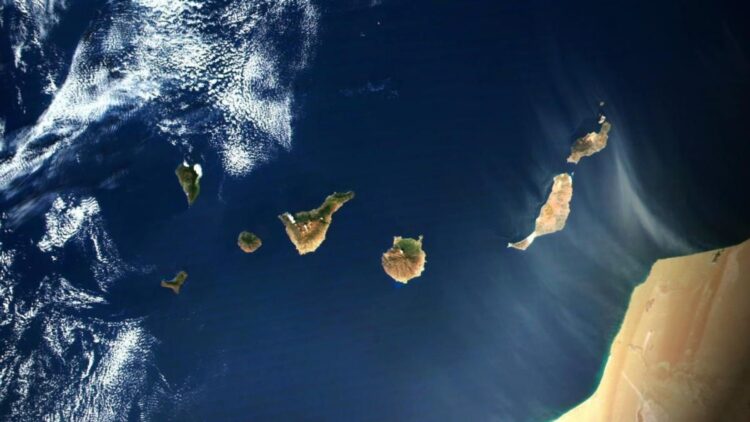
Geographical legends date back to the beginning of time and are part of the culture of the regions. This is the case of the Legend of the Island of San Borondon, in the Canary Islands. As early as the end of the 13th century, in Medieval times, in 1755, there were records of the existence of this island in Hereford’s Mappa Mundi. This island is located to the northwest of one of the westernmost islands of the Canary Archipelago, in the Atlantic Ocean.
It is also known as the Island of Saint Brendan de Clonfert, in honor of the Irish monk who came to the island in search of “paradise on earth”. The peculiarity of this island is that it appears and disappears at will, so few sightings have been made of it. The Canary Islands are of volcanic origin, which has helped researchers to explain the possibility of temporary islands that disappear when volcanic activity decreases.
Canary Islands
The origin of the Canary Islands dates back millions of years. Located in the Atlantic Ocean, they are of volcanic origin, arising from submarine and terrestrial eruptions that gave rise to the 8 islands and islets that make up the Canary Archipelago. At present, volcanic activity is still active, as could be seen after the eruption of the volcano of La Palma in 2021. On September 19, in the municipality of El Paso, a submarine cone erupted for 85 days, burying houses and towns, but with no fatalities.
San Borondon Island
To find the first appearances of the Island of San Borondon we have to go back to the Medieval Age, at the end of the XIII century. Specifically in the year 1755, when the Hereford Mappa Mundi was elaborated in England, when it was included in the map. It is represented in the shape of a ship and is estimated to be 480 kilometers long and 155 kilometers wide. If these dimensions are real, it would be the largest of the Canary Islands. What is the main characteristic of this island? Its ability to appear and disappear at will. It has been sighted only a few times, but its legend is still alive.
The best known story was told by Brendan de Clonfert in the 6th century. It was about an Irish monk who, following the orders of an angel, embarked on a 7-year voyage at sea, in search of “paradise on earth”. He arrived at a green island of volcanic origin that later became known as San Borondon. Because of its presence, it has also been known as Saint Brendan’s Island, although the truth is that nobody calls it that.
Sightings
In 1958 the Spanish newspaper ABC reported “The wandering island of San Borondón has been photographed for the first time”. Legends went so far as to describe it as the island of sandy beaches and pure gold. In 2011, the same newspaper again published “The mysterious island of Sirena, northwest of El Hierro (Canary Islands), has been seen again.” It added “history tells us that the island of San Borondón has only been sighted a few times, always disappearing under the clouds-and this tradition remains intact”.
Legend or reality?
Although some believe that the existence of this island is nothing more than a myth or a legend of the Canarian people, many others fervently defend its existence. So far no exact scientific explanation has been given to explain this phenomenon, although some physicists believe that the answer may lie in its volcanic origin. They explain that, due to submarine activity, there could be the existence of temporary islands that disappear when volcanic activity decreases.