
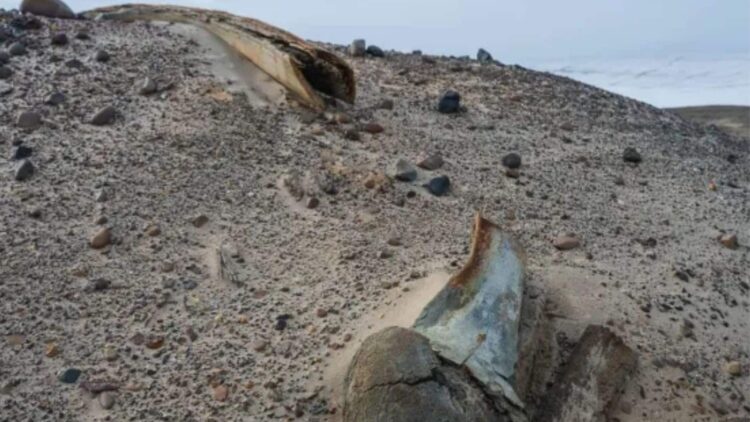
The northern Arctic Ocean has been the main stage for the latest finding of great relevance to Paleontology and Geology. Specifically, it concerns the Franz Josef Land archipelago, on Wilczek Island. Thanks to the melting of a glacier on the island, researchers from the Arctic and Antarctic Research Institute of Russia (AАНИИ) were able to record the finding in this Russian polar region. It is a “graveyard” of whales and cetaceans, which has been discovered under the glacier, which has split in two, exposing it. The documentation of this finding was made possible thanks to an expedition belonging to the “Floating University of the Arctic 2025” program.
This expedition was carried out on the research vessel Professor Molchanov. According to the scientists, this is one of the most revealing discoveries of the century. The value of this finding lies not only in the discovery of extremely well-preserved fossils, as well as ecosystems that were maintained thanks to the glacier, but also in its contribution to understanding a sudden variation in sea level that occurred millennia ago. These findings facilitate scientists’ work when reconstructing the timeline of climate change that the planet has undergone over the years, specifically in the Eurasian region.
The expedition also had another objective: to understand the dynamics of permafrost in the Eurasian Arctic, which after millennia of keeping the glacier intact, eventually gave way to its breaking. Professor Alexander Marakov is the current director of the Arctic and Antarctic Institute of Russia, which has organized nearly 1,200 scientific missions in the Arctic and Antarctica and whose work is of vital importance for the study of global climate change.
Archaeological and geological discovery
On Wilczek Island, in the Franz Josef Land archipelago, north of the Arctic Ocean, a discovery has taken place with gigantic implications for the fields of Archaeology and Geology. It is nothing more and nothing less than a “cemetery” of whales and cetaceans that lived under that layer of ice in the past. The state of preservation of some of them is impressive, due to the cold of the glacier, while others were found in worse condition. The finding was carried out during an expedition of the “Arctic Floating University 2025” program, aboard the research vessel Professor Molchanov.
What happened to the glacier?
Thanks to data from AАНИИ, the glacier of Wilczek Island has undergone an astonishing change. Two decades ago, satellite images showed a single glacier, compared to the current image of two blocks with a gap between them. It was in that plain that the remains of cetaceans stranded or deceased millions of years ago were found. It is presumed that there was water, ice, a different sea level, and configurations of various solar ecosystems at that time.
Variation in sea level
This finding also helps scientists to be more precise with the timeline of climate change that the Earth has been experiencing, particularly in that area of Eurasia. Sudden warming events in some regions were already known, but the fact that such a large number of animals have been found in it suggests that it occurred much faster than expected. Besides the finding, the goal of the expedition also included studying the nature of the permafrost in the Euro-Asian Arctic. In this way, it could help to understand why the melting and breaking of the glacier is happening so rapidly.
The importance of scientific expeditions
Alexander Makarov is the current director of the Arctic and Antarctic Institute of Russia. He has lived for over a century and since its inception has organized more than 1,200 scientific expeditions in both the Arctic and Antarctica. This is an institution that leaves behind a historical and scientific legacy of incalculable value, and it has become the benchmark for studies related to global warming. The discovery of the whale graveyard and all the conclusions that have been drawn from this expedition highlight the importance of this type of work, its strategic relevance, and the success represented by these missions.