
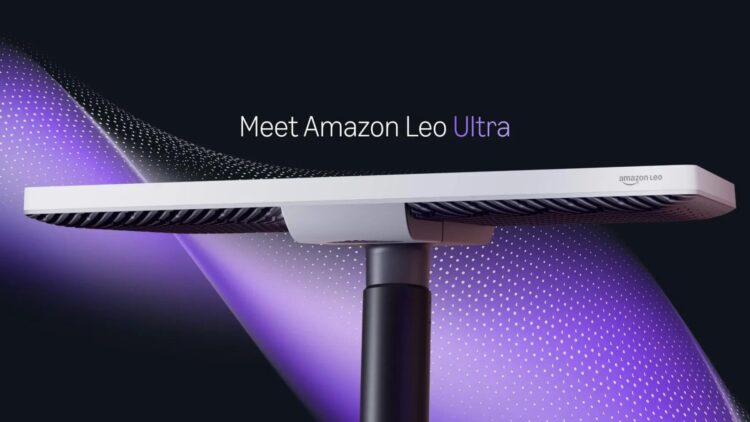
Amazon, globally recognized for its e-commerce services, has sought to go beyond package delivery to enter the satellite connectivity market. With the goal of offering low-latency broadband anywhere on the planet, the company founded by Jeff Bezos conceived Project Kuiper in 2019. In mid-November, this project evolved and was relaunched under the name Amazon Leo, a permanent brand referring to its constellation of over 3,000 satellites in low Earth orbit (LEO). According to the company, its main goal is to “close connectivity gaps in major industries, from energy and manufacturing to media and transportation.” To meet the demands of both the public and private sectors with demanding applications, Amazon has introduced a high-performance solution: Amazon Leo Ultra.
Global satellite connectivity
With the goal of formalizing the company and positioning itself in the market, what was called Project Kuiper in 2019 has now been renamed Amazon Leo. This project, launched by Bezos’ company Amazon, aims to establish a satellite communication network more advanced than the existing one. With it, they intend to provide reliable, high-speed, and affordable connections for those outside the reach of existing network infrastructures. To meet the performance demands of businesses and governments, Amazon has designed the Amazon Leo Ultra antenna. This enterprise-level device is a “full-duplex phased array antenna” that allows download speeds of up to 1 Gbps and upload speeds of up to 400 Mbps.
Amazon Leo Ultra
The Amazon Leo Ultra ground station has a robust design and, according to the company, is “weather-resistant, can withstand high and low temperatures, installs quickly, operates reliably in a wide variety of locations, and features an integrated design that eliminates moving parts.” The unit is “powered by a custom silicon chip” and incorporates an advanced design that includes “radio frequency design and Amazon’s patented signal processing algorithms to maximize performance and minimize latency.” In addition to its speed and durability, the device includes “advanced network features such as simultaneous uploading and downloading and seamless integration with existing enterprise network infrastructure”.
Business Services and Solutions
Amazon Leo Ultra not only offers hardware but also a set of enterprise-level network services. These include:
- Customer support.
- Advanced encryption across the network.
- Easy-to-use network management tools.
The technology is designed to provide secure connectivity and communications, as well as real-time data processing in remote areas where it is usually unavailable or limited. Its main feature and advantage is that it can integrate directly with Amazon Web Services (AWS), as well as with other local or cloud network infrastructures. This allows users to share data and information securely without needing to use the public network. The private network solutions provided by the service include:
- Private network interconnection: Allows companies to create private interconnections at key colocation facilities to link their remote locations to a central network or data center.
- Direct to AWS: Users can establish a direct connection to their cloud workloads. This is achieved using an AWS Direct Connect Gateway or an AWS Transit Gateway through a simple ‘point and click’ interface located in the Amazon Leo web console. This approach simplifies network management and reduces latency.
Launch
According to information published on Amazon’s official blog, there are already agreements with several companies and partners to launch a preliminary version of Amazon Leo. These include JetBlue, Vanu Inc., and Hunt E. During this phase, companies can test the network using Amazon’s production hardware and software. The Leo Ultra units have already been sent to the selected companies.
Frequently asked questions
Which Amazon Leo Ultra structure?
This enterprise-level device is a “full-duplex phased array antenna” that allows download speeds of up to 1 Gbps and upload speeds of up to 400 Mbps.
What does it private connectivity offer?
Its main feature and advantage is that it can integrate directly with Amazon Web Services (AWS), as well as with other local or cloud network infrastructures. This allows users to share data and information securely without needing to use the public network.