
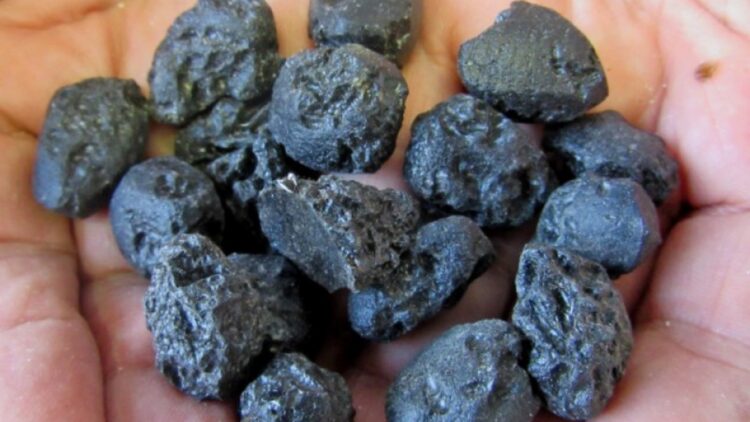
The South Australian Museum in Adelaide, South Australia, held a secret that all scientists were unaware of, and that has now come to light. It concerns a series of small black natural glass fragments that were associated with a meteorite impact from about 780,000 years ago. These remains are known as tektites, which have mostly been found from Southeast Asia to Australia. However, after being studied by a team from Aix-Marseille University in France and Curtin University in Australia, under the leadership of geologist Anna Musolino, it has been determined that these remains have a different chemical composition from those found so far.
After the analysis, they have been able to determine that they are 11 million years old, so they do not correspond to the meteor impact that was proposed. For this reason, a new category has been created to include this new finding: the ananguitas, in honor of the Anangu culture, where most of these findings have been discovered. It is believed that the meteor impact would have generated a tektite field of about 900 kilometers, but so far it has not been found. Based on the analysis data and their composition, scientists believe they could be found in areas of intense volcanic activity such as the Philippines, Indonesia, or Papua New Guinea; however, these are all just theories.
A secret in plain sight
For years, fragments of natural black glass the size of a coin were kept at the South Australian Museum in Adelaide, Australia, which were initially dismissed as unimportant. However, more than half a century later, it has been discovered that this is a very significant find, as these remains are completely unrelated to what has been studied and analyzed so far.
Tektites, Ananguites
Tektites are fragments of natural glass that originate when a meteorite impacts the Earth’s surface at such a velocity that it melts the rocks on the ground. This molten material is ejected kilometers away, cooling rapidly before falling to the ground, forming what is known as ‘strewn fields.’ So far, they have been discovered in regions from Southeast Asia to Australia. However, these new fragments show a different chemical composition: they have higher density and unusual levels of nickel and chromium. Additionally, their age is greater than previously thought, around 10.76 million years.
Why has it been found now?
As early as 1969, a study indicated that in Australia there were some remains with a strange composition, but no one paid much attention. It is only now that a team of scientists from Aix-Marseille University in France and Curtin University in Australia, led by geologist Anna Musolino, has resumed this research. After analyzing a sample of 5,000 specimens, 417 tektites were considered suspicious. Following this new finding, they created a new category, ananguite, referring to the Anangu people, where most of these remains have been discovered.
Where is the impact crater?
Although scientists locate it in a region of intense volcanic activity such as Luzon (Philippines), Sulawesi (Indonesia), and Papua New Guinea, the truth is that these are all theories. However, the anangkuitas captured chemical and physical traces of that geological past of the Earth, which represents great value. They contain inclusions of a type of amorphous silica called lechatelierite, which only forms at extremely high temperatures.
What now?
Having found and studied the ananguitas, this opens the door for other museums to review their collections in search of increasing the existing number.