
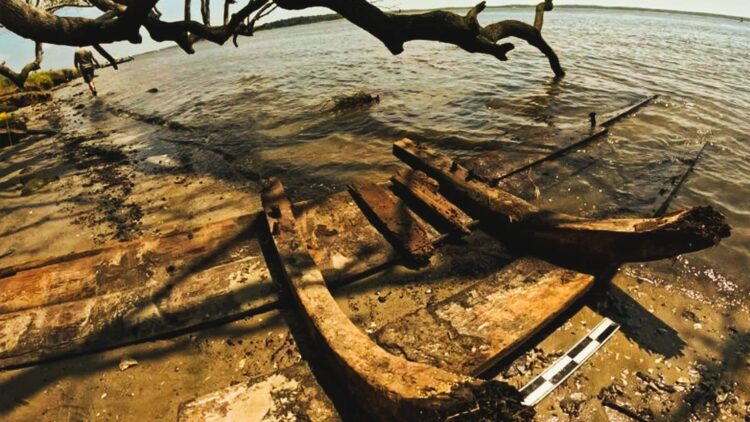
The depths of the seas continue to hold secrets that we often believed were forgotten. This is the case of the Spanish privateer La Fortuna, one of the most feared ships of the 18th century. It was thanks to the efforts of a team of university students that it was found in the waters of North Carolina, where the Cape Fear River flows into the Atlantic. The sinking of the privateer occurred in 1748, during the War of Jenkins’ Ear, where Great Britain faced France and Spain. The port of Brunswick was attacked by the Spaniards, who ultimately died from an explosion aboard the privateer.
The loot recovered from the shipwreck was used to finance two colonial churches, one in Brunswick and the other in Wilmington. The findings revealed that the wood fragments were made of Monterey cypress or Mexican cypress, which could only be obtained in Spanish America. Both the wood and the other remains have been transferred to the Queen Anne’s Revenge conservation laboratory in Greenville, where it is expected to be analyzed in depth and receive specialized treatment to slow down its degradation.
La fortuna
It was one of the most famous ships of the Spanish Empire of the late 18th century. It was one of the protagonists in the War of Jenkins’ Ear (1744-1748), during which the British were attacked. This war pitted Great Britain against France and Spain. It had a tragic ending, sinking after an explosion on board while attempting to attack the British in Brunswick Town. The war took place on the shores of southern North Carolina, where the Cape Fear River meets the Atlantic.
The attack of 1748
This important historical fact took place in 1748, during the War of Jenkins’ Ear. This conflict pitted Great Britain against France and Spain. The Spanish privateer from Cuba, La Fortuna, planned a coordinated attack on the port of Brunswick, which tragically ended for the privateer. The Spanish crew disembarked and occupied the city of Brunswick, but they did not anticipate the strength of the local British militia.
The crew ended up returning aboard their ship after harsh confrontations on land. From the ship, they continued the offensive with artillery fire until an accidental explosion occurred on the ship, causing it to sink and ending the life of the captain and a good part of the crew. It was after the shipwreck that the British recovered the loot on board and allocated it for the construction of two colonial churches; one in Brunswick and the other in Wilmington.
The discovery of La Fortuna
It was thanks to a group of marine archaeologists and university students that they decided to set out and search for the remains of the most feared corsair of the Spanish Empire. The discovery took place during a summer campaign at the site of Brunswick Town/Fort Anderson, where more than forty fragments of wood have been found. The identity of the ship is supported not only by the nearby presence of a cannon and the location of the remains, but also by the type of wood from the fragments, Monterrey cypress or Mexican cypress, which was only found in Spanish America.
In addition to the remains of what is believed to be La Fortuna, remains of three other shipwrecks were also located. One is thought to have served as fill in the area of the colonial wharf, another could have been a flatboat used for transporting goods, and the third remains a mystery for researchers.
What will happen to the remains of the ship?
The fragments found have been transferred to the Queen Anne’s Revenge conservation laboratory in Greenville. There, they are expected to receive specific treatment to slow their deterioration, as well as undergo more in-depth analysis. This type of discovery sheds light on the study of the relationships that existed in the 18th century, both in the naval field and in commerce, as well as in the control of maritime routes between Europe and America.