
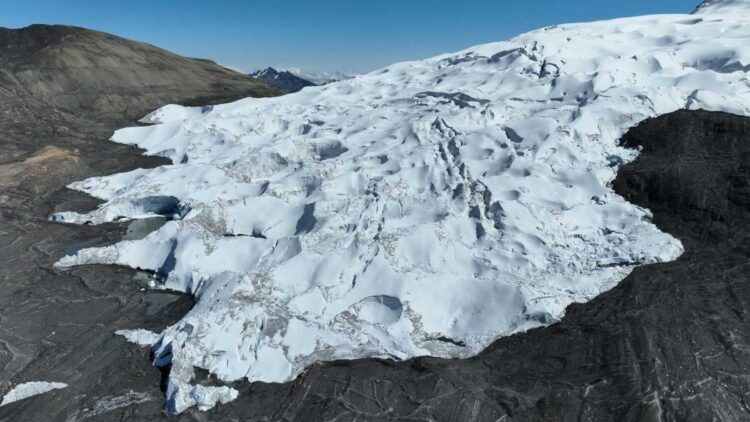
Many glaciers‘ survival or disappearance can be highly influenced by more than air temperature and snowfall. For years, this has been the way scientist predict their future. However, a recent global study published in Nature Communications reveals that avalanches were a crucial component missing from this picture.
The researchers discovered that in many locations, what slides down from nearby cliffs also affects a glacier’s future. Avalanches can slow the glacier’s retreat in some areas because they bring so much additional snow. In others, the glacier shrinks more quickly because it remove snow.
Avalanche snow is a global process that affects how much water glaciers store, how stable mountain slopes are, and how accurate our climate projections can be, according to the team’s analysis of more than 200,000 glaciers worldwide.
How avalanches can both protect and damage glaciers
The amount of snow a glacier receives has to match or exceed the amount of ice it melts in order for it to survive. Typically, we think that snow just falls on top of the glacier. However, a lot of snow moves.
Globally, avalanches only add a few percentage points to a glacier’s overall snowfall. However, in extremely steep, snowy regions like the European Alps, the eastern Himalayas, or New Zealand, avalanches become a major factor. There, some of a glacier’s total snowfall may come from snow that first fell on nearby slopes before sliding down. This transport makes up more than half of the annual accumulation in some places.
Some small glaciers are “fed from above.” They receive additional snow that slides down from higher slopes because they are tucked away in small valleys with steep walls, partially compensating for the lack of direct snowfall.
However, avalanches behave like a snow vacuum on extremely steep terrain. They remove new snow from areas like the tropical Andes, increasing the glaciers’ exposure to heat and accelerating their melting.
A new way to model glacier futures
The researchers developed a technique that combines a global glacier model with a snow-redistribution model that monitors the monthly movement of snow on steep terrain in order to fully understand this process. This is the first time that all of the glaciers on Earth have been treated with this kind of strategy.
The avalanche model predicts where snow is likely to slide and how much snow “doesn’t fit” on slopes too steep to support it. Using this data, the team adjusted each glacier’s snowfall data to produce a more accurate representation of how much snow each one actually retains. This clarified why some glaciers seemed to receive more snow than what weather records suggested.
They then ran a global glacier model that can simulate future ice evolution up to 2100 and reconstruct historical changes.
One of the most remarkable findings can be found in the European Alps: when avalanche snow is considered, small glaciers smaller than one square kilometer can store up to three times as much ice in low-emission scenarios. This helps explain why some small glaciers have endured longer than anticipated by earlier models.
However, the amount of snow available decreases due to rising temperatures and a higher snowline, and the extra avalanche input is not enough to balance the melt.
Looking for more accurate glaciers data: understanding how avalanches work
Many valleys rely on glacier meltwater for drinking water, hydropower, and agriculture. River flows can be predicted and water use can be planned by knowing which glaciers will disappear more quickly.
Scientists say they still need more field data and improved satellite observations, so this is just the beginning, but deeper studies can be very helpful for the communities living below.