
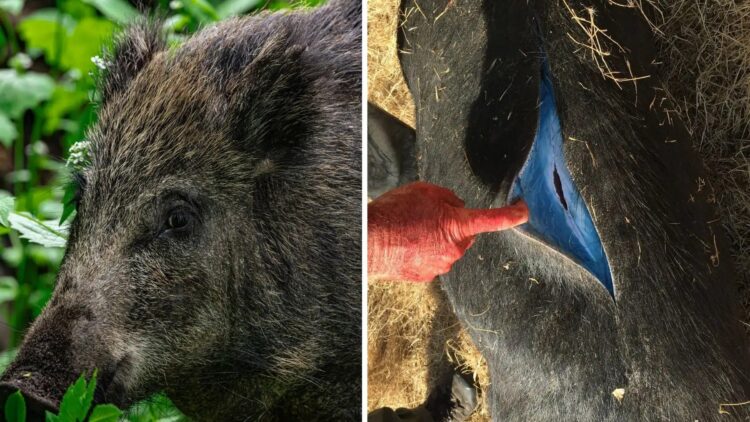
The California Department of Fish and Wildlife (CDFW), through its pesticide research coordinator, Ryan Bourbour, has warned about contamination of wild pig meat due to rodenticide poisoning. The warning has included the entire Monterey County area, following alerts from hunters. They realized the poisoning after discovering that the pigs’ meat was blue. Dan Burton, owner of a wildlife control company, witnessed it and communicated it to Salvador Hernández at the Los Angeles Times.
The CDFW advises ensuring that declared wildlife will not be affected by the use of this type of pesticide, which not only affects the animal that ingests it but also humans who may eat that meat. The use of chemical pesticides has been affecting many ecosystems for years. That is why wildlife groups around the world have long been urging to stop relying on chemical pesticides, as the collateral damage to animals and humans is highly harmful.
Alert in Monterrey, California, over “blue meat”
Monterey County, in California, United States, has received a warning from the California Department of Fish and Wildlife (CDFW) after several hunters found that the meat of wild pigs had a blue color. According to the owner of a wildlife control company, Dan Burton, in his statements to Salvador Hernández in the Los Angeles Times, “I’m not talking about a little blue. I’m talking about neon blue, blueberry blue”.
After investigations by the authorities, it was determined that the blue color of the animal meat was due to poisoning caused by ingestion of rodenticide. According to the coordinator of pesticide investigations at the California Department of Fish and Wildlife (CDFW), Ryan Bourbour, “Hunters should be aware that the meat of game animals, such as wild pigs, deer, bears, and geese, can be contaminated if that animal has been exposed to rodenticides. Exposure to rodenticides can be a problem for non-target wildlife in areas where applications occur very close to wildlife habitats”.
What is rodenticide?
Difacinona is a first-generation rodenticide that acts as an anticoagulant, causing severe internal bleeding, commonly used to control rodent pests in agriculture. Its action is triggered when it binds to an enzyme that recycles vitamin K, reducing it and making it impossible for the liver to produce enough clotting factor to prevent internal bleeding. Even after the chemical breaks down, Difacinona remains active in the tissues of the dead animal for some time, so predators and humans who consume this meat can become ill from the toxin.
Recommendations
The CDFW stated, “Pesticide applicators are urged to take precautions when applying rodenticides to avoid exposing wildlife. Before applying the pesticide, it is important to ensure that wildlife is not using the area where it will be applied. It is also important to use appropriate bait stations and application methods that prevent access by non-target species”.
Use of chemical pesticides
It is not new that wildlife groups and the rest of the population, as well as authorities, advise against the exclusive use of chemical pesticides, due to the large number of collateral damages they cause. Wildlife is completely harmed, as are their ecosystems, as residues have been found in the systems of many poisoned predators, including raptors, mountain lions, bobcats, foxes, as well as the endangered northern spotted owl and the San Joaquin fox.
Regarding humans, a recent study conducted in the United States found residues of the insecticide chlorpyrifos, which causes structural abnormalities in the brain and affects motor function in children and adolescents. According to the study, “The excessive and uncontrolled use of pesticides has led to contamination of food, as well as environmental, agricultural, and aquatic pollution. To address the global threats posed by pesticides, international coordination and cooperation between nations are essential.”