
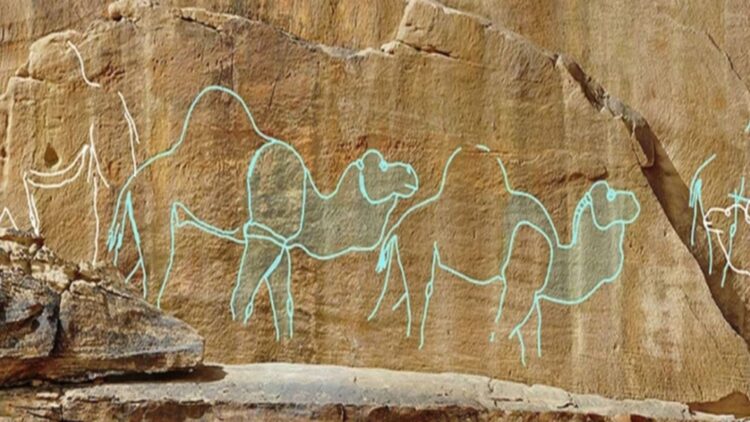
The journal Nature Communications has published the findings of an international group of archaeologists that have overturned the understanding previously held about human settlement in the Arabian Peninsula. The discovery includes a collection of rock art believed to be over 12,000 years old, focusing on more than 170 engravings distributed across cliffs near the southern edge of the Nefud Desert in Saudi Arabia.
The panels were found in three previously unexplored areas: Jebel Arnaan, Jebel Mleiha, and Jebel Misma. This discovery not only establishes an older timeline for figurative rock art, but also reveals the existence of extended cultural networks reaching the Levant, 400 kilometers away, and underscores the importance of seasonal lakes as crucial survival points following the extremely arid Late Glacial Maximum period.
Discovering camel carvings
Erosion and the passage of time have taken their toll, leaving behind many examples of rock art from our ancestors. However, in May 2023, a team of international researchers decided to travel to a region near the southern edge of the Nefud Desert in Saudi Arabia, where they aimed to find ancient rock art. These were pieces that were not included in the UNESCO World Heritage and which they wanted to study. The team was able to identify more than 60 rock art panels with 176° in 3 a, which had not been explored until now: Jebel Arnaan, Jebel Mleiha, and Jebel Misma.
The images, which show 130 engravings, include large, life-sized animals such as camels, goats, Montesa, donkeys, wild animals, gazelles, and uros. According to Maria Guagnin, “The rock art panel showed two large camels, one on top of the other. The older camel looked as if it were in motion and about to stand up, the other as if it were walking on the rocky surface. The same layer also contained artifacts typical of this period, including small arrowheads, stone beads, and even a bead made from a shell”.
Through the luminescence dating method, which can measure when the sediment was last exposed, they were able to determine that the layer in which an engraving tool was found dated back 12,000 years.
Implications of this new study
The results of the datings of these engravings imply the long-range movement of the people who created these examples of rock art. They demonstrated the use of the same stone tools and jewelry as the communities of the Levant, 400 kilometers further north, revealing their connection. In addition to the dating, the team was also able to reveal that the new site to be explored had been a seasonal lake 15,000 years ago, whereas it is now an arid desert. This change corresponds to the return of surface water to Arabia after an extremely arid period. This alters the timeline in which humans could settle under these climatic conditions.