
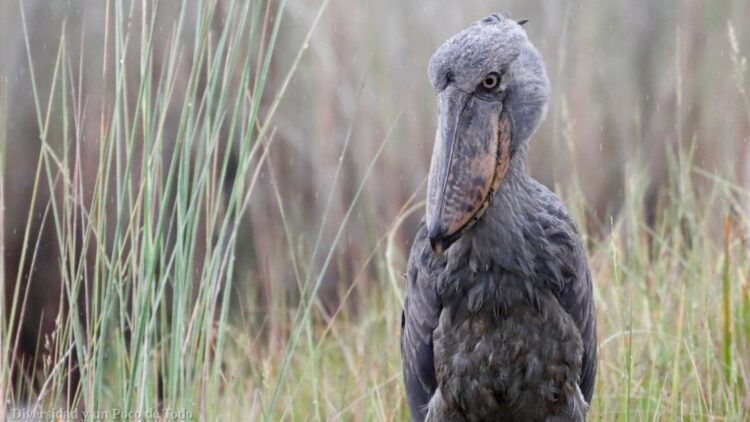
More and more species are being threatened not only by climate change and its consequences but also by human actions. This is the case of the Shoebill, also known as Whalebill, which inhabits swamps and wetlands in Uganda, Rwanda, Zambia, and South Sudan on the African continent. It is one of the endangered species that has fewer than 5,000 individuals in the wild, while the rest are in captivity. Some institutions have studied these vulnerable bird specimens, trying to understand and meet their needs, as has been done by Pairi Daiza in Belgium. It is a hunter with deadly precision, also aided by its size.
From chicks, they learn to hunt to survive in the African wetlands, as the parents cannot provide food for all the young. Those who overcome this challenge can live up to 35 years in the wild and 50 in captivity. Despite all their physical and hunting characteristics, it is one of the most threatened species in East Africa due to human action. For this reason, the International Union for Conservation of Nature (IUCN) has classified it as ‘vulnerable’ due to issues such as pollution, illegal trade, and habitat destruction.
Shoebill, Whalebill
Its name responds, as is evident, to the shape of its enormous beak. It is a species of pelicaniform bird from the family Balaenicipitidae, of the genus Balaeniceps. Its scientific name is Balaeniceps Rex, and it is one of the native species of East Africa. Some experts believe it has a somewhat prehistoric appearance, referring to the impression of its face. It is present in the African wetlands of Uganda, Rwanda, Zambia, and South Sudan, where it feeds on fish, amphibians, snakes, and even small crocodiles!
Survival instinct
With a height of 1.2 meters and a wingspan of 2.3 meters, it is the species responsible for the decline of other species with which it shares its habitat, due to the struggle for survival. It is precisely this skill that they acquire from the time they are chicks, when they have to fight for their own survival because the parents are unable to supply food to all the offspring. “In addition to being ruthless with the animals it hunts, this relative of the stork quickly learns to become a predator to ensure its survival,” explains Explora. This species has an average lifespan of 50 years in captivity and 35 in the wild.
What problems does this species of hunting bird face?
As if having to face the struggle for survival from an early age wasn’t enough, shoebills face even more problems that threaten their survival as a species. It is true that they are a species with a truly fearsome appearance, as well as a fierce and ruthless hunting instinct, but none of that justifies the threats they face. Research has been conducted at Pairi Daiza in Belgium aimed at understanding and meeting the needs of these birds, with the goal of changing their situation. According to the International Union for Conservation of Nature (IUCN), the shoebill or whalebill is a species that has been classified as “vulnerable”.
What are the threats that they are facing? According to the IUCN, one of the threats is the illegal trade of species, whether they are protected or not. On the other hand, pollution is mentioned, primarily caused by humans, as well as the destruction of their habitat, as a consequence of all these actions.We can only hope that the actions taken at the institutional level have an effect, and above all, that the actions that depend on human hands comply with the law to prevent shoebills from suffering the final fate that, unfortunately, other extinct species have already suffered.
Discover how climate change has affected the habitat of one of South Carolina’s most iconic birds.