
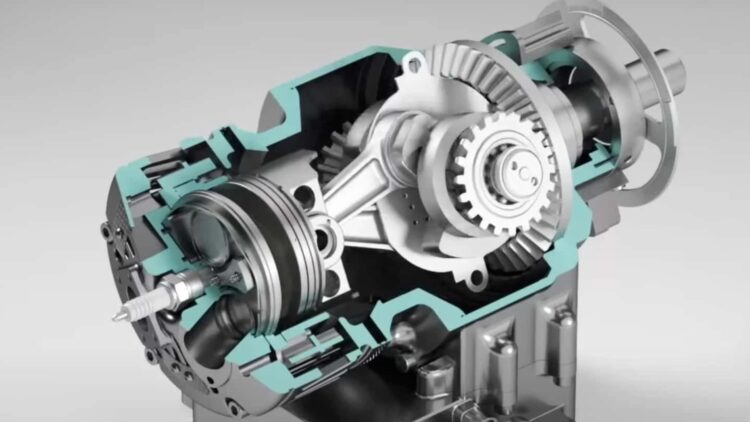
The advancement in technology related to automobile engines is experiencing a considerable increase, satisfying the need for companies to achieve the manufacture of the most efficient alternative engine. The common goal of companies is to reduce carbon emissions by eliminating the internal combustion engine and betting on alternative engines, such as electric engines, hybrids, or hydrogen engines. Although Tesla led the way with electric engines, brands such as Japanese Toyota and Hyundai have already joined the list with their hydrogen fuel engines. The latest to want to join has been the Indian automobile manufacturer, Avadi.
Its arrival has been very powerful, as it has brought with it the design of a “self-rotating” engine. Although it is still a prototype, the company believes it can improve existing electric motors. They also hope it will be adopted by major manufacturers such as General Motors and Ford. The automotive industry has an increasingly large catalog, which also indicates greater competition among companies. This is the case for the South Korean manufacturer, KIA, which announced that next year their new compact electric SUV model, the E3, will be seen on the roads of the United States.
Automobile engine technology
The last decade of the automotive industry has been marked by the intention of manufacturers to move away from internal combustion engines and replace them with alternative engines. This dynamic responds to the need to reduce carbon emissions into the atmosphere and to steer production towards a more sustainable model. With these advancements, alternative engines have emerged, such as electric, hybrid, or hydrogen fuel cell engines. There are even brands that are experimenting with solar cars. Undoubtedly, Tesla, which was the market leader for a long time, made its mark with the arrival of its electric motor vehicles.
Gradually, more brands began to replicate this by launching hybrid and electric models. However, the latest additions come from the Japanese companies Hyundai and Toyota, which have bet on hydrogen engines. It is fair to say that the sale of electric vehicles has declined and what was once an attractive option for consumers has ceased to be so. However, it is considered relevant that manufacturing companies continue to offer these options, as they are the path towards more sustainable mobility.
“Self-rotating” engine
In the list of innovations within sustainable driving, the Indian company Avadi has aimed to join, which is making a strong impact. They have presented the design of a rotary engine that replaces the traditional rotary engine through the development and incorporation of a rotating piston. According to their official website, the new design consists of “…two connecting rods and their corresponding pinion gears reside in what we call a ‘middle shaft’… the middle shaft can be compared to the heart of the Avadi design, it is essentially the casing where the up and down motion of pistons translates into rotational movement”.
It is worth noting that it is still a prototype, but the company has great faith that it can improve existing electric motors. The potential of their design is such that large companies like General Motors or Ford could incorporate it into their manufacturing.
Competitive market
While the design of Avadi remains just a prototype, other companies are moving forward with the development and market launch of their products. This is the case for KIA, the South Korean automobile manufacturer, which has announced that next year compact SUV models will be seen on the roads of the United States. It specifically refers to the most recent, the electric compact SUV E3, which will have to compete with domestic brands like Ford.
Toyota and BMW team up to lead the hydrogen engine market in the automotive sector!