
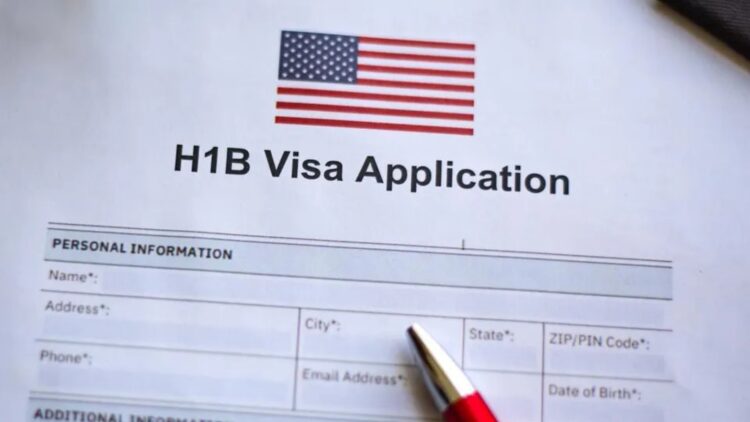
From now on, going to work in the United States will have an additional difficulty: the $100,000 fee to apply for the H-1B work visa. This new measure was approved by President Donald Trump last week in the Oval Office at the White House, on the grounds that it is a way to encourage companies to hire American workers. The method of payment is still under discussion with the Department of Homeland Security, as it has yet to be decided whether it will be a one-time payment of $300,000 in advance, or an annual payment of $100,000.
This is another step in Trump’s immigration policy, which aims to eliminate (or at least make it very difficult) immigration to the United States. In one of his latest statements to the New York Post, Trump said that he is in favor of the H-1B visa, but that companies should prioritize hiring American workers.
H-1B Visa
The H-1B visa, as described on the official website of U.S. Citizenship and Immigration Services, is a non-immigrant visa category that applies to individuals who want to provide services in a specialized field, services of great merit and exceptional skills for development or cooperative research projects with the Department of Defense (DOD), or as high-fashion models or for advertising with great merit or distinguished ability.
The eligibility requirements must be met in order to obtain it, and it facilitates companies operating in the United States to hire non-U.S. personnel. They have a duration of 3 years, extendable for another 3 years when the initial period ends.
$100,000 for an H-1B visa
Last Friday, September 19, President Donald Trump took another step toward tightening his immigration policy. This time, in the Oval Office of the White House, he signed an executive order through which H-1B visa applications will have a fee of $100,000. According to Trump, “We need great workers, and this practically guarantees that this is what will happen.” The only remaining detail to be clarified, which is currently under discussion with the Department of Homeland Security, is whether an advance payment of $300,000 will be required, or, on the contrary, $100,000 will be charged for each year the visa lasts, annually.
What does Trump say?
Currently, 65,000 visas of this category are granted in the United States. Of this total, 40,000 are for foreigners and 25,000 for graduates from the country’s universities. These figures are far from pleasing the president, who had previously opposed this visa program, arguing that American companies should prioritize hiring local staff. In fact, he went so far as to say that companies used the H-1B visa “with the explicit purpose of replacing American workers with lower wages.”
Now, with his open campaign and fight against immigration in the United States, he declared to the New York Post: “I have always liked visas, I have always been in favor of visas. That is why we have them.” He likes visas but deems it appropriate to impose a fee to make it more difficult for foreign workers to enter the country.
What seems like a glimpse of flexibility has been their approval of the hiring of foreigners who graduate from universities in the United States. They went so far as to declare that legal status could be granted to some workers born abroad, but who had completed their studies and graduated from U.S. universities. However, the reality is that they have also made it very difficult for foreign students who want to study in the United States, with extremely expensive visas that make students, unable to afford them, choose other destinations for their education.