
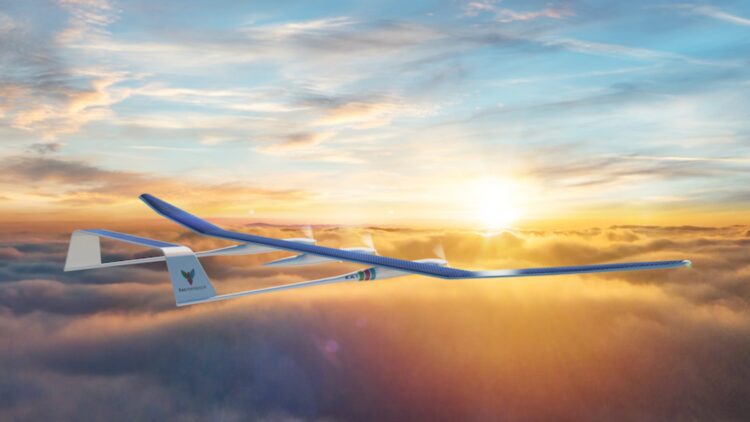
The company Kea Aerospace, together with Li-S Energy, is revolutionizing the way High Altitude Platform Station (HAPS) aircraft operate. They have achieved this with the development of the UAV ATMOS, which will be capable of flying for months without landing, powered by solar energy. This fleet of aircraft, named ATMOS, can reach altitudes of 55,000 to 65,000 feet. The distinguishing feature of these aircraft is that they are entirely powered by solar energy and use lithium-sulfur (Li-S) batteries from Li-S Energy.
These batteries will first be implemented in the ATMOS Mk1 and later in the Mk2 version, with flights designed to last months. The collaboration between both companies has led to a completely new concept in global aviation, remote sensing, and the use of clean energy. In addition to being able to fly for months without producing emissions, ATMOS is also capable of functioning like a satellite, collecting data from the sky.
Kea Aerospace
Originating from Christchurch, New Zealand, it is a company that develops high-altitude (HAPS) solar unmanned aerial vehicles (drones). This is the case with their latest model, ATMOS, designed to operate in the stratosphere. Its main goal is to provide high-resolution aerial imagery for applications such as environmental monitoring, precision agriculture, disaster management, and maritime domain awareness.
These drones can stay in the air for long periods, above commercial air traffic and weather conditions. The development of the ATMOS UAV was made possible thanks to collaboration with the company Li-S Energy. It is a vehicle with solar-harvesting wings and a 12.5-meter wingspan. The uniqueness of this aircraft lies in its ability to reach altitudes of 55,000 to 65,000 feet, and the length of time it can stay in the air, powered solely by solar energy.
Lithium-sulfur batteries
Founded in 2019, Li-S Energy is an Australian company whose goal is the development and commercialization of lithium-sulfur and lithium-metal batteries. This type of battery is useful in various sectors, such as electric mobility, aviation, drones, and electronic devices. In the case of the collaboration with Kea Aerospace, it will involve lithium-sulfur materials, which are capable of producing twice the energy density of traditional lithium-ion cells without having to rely on highly harmful materials such as cobalt.
In addition, one of the conditions for making flights longer-lasting is the weight of the battery, so reducing their mass was one of the main objectives to ensure the missions of these aircraft. Initially, the battery will be integrated into the ATMOS Mk1 and later into the Mk2. During the day, the batteries will be recharged with sunlight, and energy will be the source for the aircraft’s operation throughout the night.
Kea Aerospace and Li-S Energy
The union and collaboration between these two leading companies in the aviation world has undoubtedly revolutionized what the sector understood as global aviation, remote sensing, and the use of clean energy. In addition to marking a before and after, the ATMOS series is also capable of functioning as a satellite, collecting data over a longer period of time without the need to stop for refueling, and without producing any emissions. Other aircraft that have also stood out in this sector include the BlackBird and the PHASA-35, which flies above 65,000 feet.