
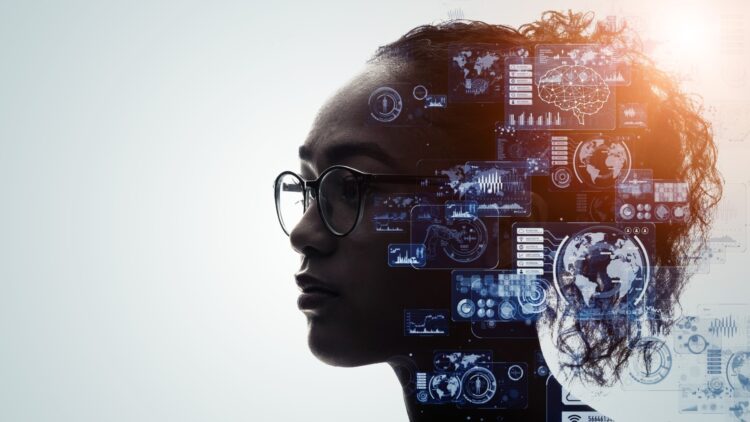
It is very easy to make predictions about topics that have a simple development or outcome. The predictions that have value are those that propose new ideas about how the future could be, beyond what is merely foreseeable or expected. This is the case of Ray Kurzweil, an American computer scientist who introduced the term “the singularity”.
This term refers to the union of human intelligence and artificial intelligence. Already in 1999, Kurzweil predicted that by 2029 humanity would be able to develop an artificial intelligence capable of performing a trillion calculations per second. In 2005, he published his book The Singularity is Near, and in 2024 he modified the title to become The Singularity is Nearer.
In it, he continues to hold on to the predictions he made in 2005, and adds that by 2045, humans will achieve intelligence one million times greater, thanks to the fusion of natural intelligence and cybernetic intelligence, with the use of brain interfaces with nanobots. Although this fusion of intelligences may seem like an idea taken from Back to the Future Part II, researchers from the University of Oxford such as Marcus du Sautoy and Nick Bostrom assert that it is not a crazy idea.
Future predictions
Great futurists have not succeeded because they are predictable in their statements or because they choose the simplest predictions. It could be said that the greatest exponents of futurism are the Simpsons, and there is no denying that. But beyond that, there have been great classics in cinema like Back to the Future II, which have not exactly hit the mark with their predictions, but have proposed ideas that have helped to see other possible realities that we could face, technologically speaking.
Ray Kurzweil
Who is Ray Kurzweil? A multidisciplinary American, musician, entrepreneur, writer, and scientist specializing in Computer Science and Artificial Intelligence. Born in Queens, New York, he has been leading the Engineering Department at Google since 2012. He is one of the proponents of the belief that humanity will evolve into what he calls ‘the singularity.’ So much so that as early as 1999, he declared that humanity would achieve general artificial intelligence by 2029, when it would be capable of performing a trillion calculations per second.
Although these theories were mocked by his peers, the current situation is not so far from his predictions. In 2005, he published his book The Singularity is Near, with a second version released in 2024, which continued to support his initial theories, as well as doubling them. In one of his TED talks, he stated that by the year 2045, humans will be able to achieve an intelligence a million times greater. How will this be possible? According to Kurzweil, we will have the help of nanobots that can be non-invasively inserted into our capillaries, which will have brain interfaces.
In one of his interviews with The Guardian, he declared, “We are going to be a combination of our natural intelligence and our cyber intelligence; everything will come together as one. We are going to expand intelligence a million times by 2045, and it will deepen our consciousness”.
What do other scientists say?
Other voices like those of Oxford researchers Marcus du Sautoy and Nick Bostrom stated in 2024 that in one way or another, a model of fusion of intelligences with AI will be reached, and perhaps we won’t have to wait that long. Sautoy told Popular Mechanics, “I think we are heading towards a hybrid future. We still believe that we are the only beings with a high level of consciousness. This is part of the whole Copernican journey that we are not unique. We are not at the center”.
Discover what uses are being given to AI today. Did you know it could even sell you a car?