
If the World Wide Web (WWW) is already spread across practically the entire planet, what prevents it from spreading throughout the galaxy? This is precisely what they had been asking at NASA, because they have recently demonstrated possessing technology that could be used to send messages at a distance of almost 16 million kilometers (10 million miles) via laser. This test was part of NASA’s Deep Space Optical Communications (DSOC) experiment, and achieving that communication is referred to as ‘first light’.
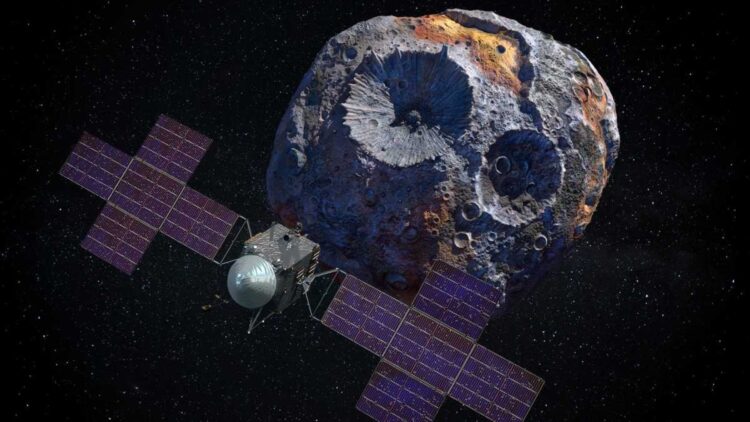
In the case of space, communication would be through infrared light emitted in waves in the form of laser. Achieving this goal presents two main challenges. On the one hand, heavy instruments are required, such as a high-efficiency superconducting detector, and on the other hand, ensuring that the transmission occurs in real-time, without delays. The Psyche spacecraft has been on a mission for years heading towards the asteroid belt between Mars and Jupiter.
It made contact with the Hale telescope at the Palomar Observatory in California, and she is the current carrier of the laser therapy transceptor that managed to make the connection. A flight around Mars has been scheduled for her, with which they aim to continue testing and perfecting this idea. Despite the fact that there is still much work ahead, the operations leader of the DSOC at NASA’s Jet Propulsion Laboratory (JPL), Meera Srinivasan, expressed optimism about what has been achieved so far.
Internet in space
What would happen if space enjoyed planetary internet? It would certainly be a breakthrough in communications to and from Earth, along with the rest of the missions currently in operation. NASA has good news regarding this, as they have initiated efforts to achieve greater space connectivity, as if the World Wide Web (WWW) were expanding throughout the galaxy. Recently, the agency announced that they have a piece of technology that has allowed them to send messages via laser over a distance of 16 million kilometers (10 million miles).
What is NASA’s plan?
One of their latest statements, NASA explained that they have been able to send messages via laser over quite considerable distances. In fact, the 16 million kilometers reached correspond to about 40 times farther than the distance from the Earth to the Moon. It was last November when this achievement took place, and since then they have been working on it. Currently, radio waves are used to establish communications with spacecraft that are at considerable distances. However, what is proposed now is to make use of the near infrared, which offers an increase in data speed thanks to bandwidth. This test was part of NASA’s Deep Space Optical Communications (DSOC) experiment, and the communication success has been dubbed “first light.”
Problems to solve
The Director of Technology Demonstrations at NASA headquarters, Trudy Kortes, stated, “Achieving first light is one of the many critical milestones of DSOC in the coming months, paving the way for higher speed communications capable of sending scientific information, high-definition images, and video transmissions to support humanity’s next giant leap.” Although experts explain that transmitting infrared light waves with a laser is not a complicated task, there are several open fronts still to be resolved.
On one hand, heavy instruments are required, such as a high-efficiency superconducting detector, to decode the bits of data found in the photons emitted by the laser. This implies that information needs to be prepared and translated at the destination. On the other hand, they need the positioning technology to adapt in real-time, as in their last test the laser photons experienced a 50-second delay.
Spacecraft Psyche
The Psyche spacecraft is the current bearer of the laser transceiver that managed to establish this connection. It is on a mission directed to the asteroid belt between Mars and Jupiter, and it has even made contact with the Hale telescope at the Palomar Observatory in California. A flight to Mars has been scheduled to continue testing and perfecting the connections. The operations lead of the DSOC at NASA’s Jet Propulsion Laboratory (JPL), Meera Srinivasan, stated, “It was a formidable challenge, and we have much more work to do, but for a brief moment we were able to transmit, receive, and decode some data”.
The Sagittarius A black hole reveals an unexpected secret. Want to find out?