
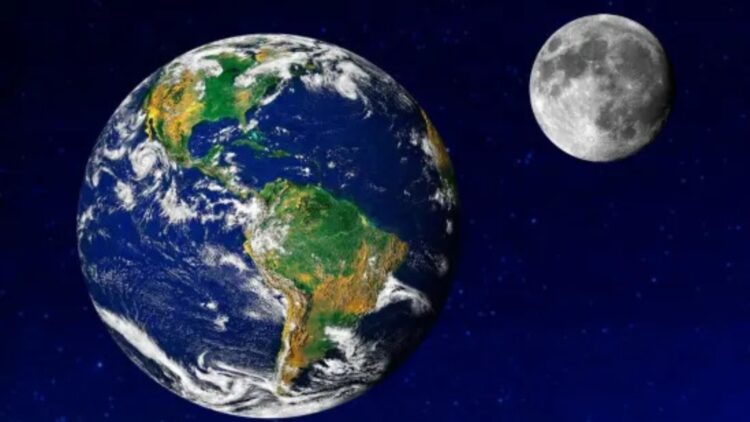
Scientists are celebrating, as they have been able to explain, after a long time of unknowns, the presence of iron oxide (Fe₂O₃) on the lunar surface. How is this possible if there is neither air nor water on the Moon? A study published in Geophysical Research Letters explains that the formation of this oxygen does not occur on the Moon, but rather arrives from Earth. This wind from Earth, originating from the Earth’s magnetosphere, is composed of charged particles that reach the Moon. Thanks to the Moon Mineralogy Mapper (M3 mission), scientists identified hematite deposits in the polar regions of the satellite, specifically in those closest to Earth.
In this way, it has been demonstrated that the Earth’s wind, which includes oxygen ions, can reach the lunar surface and interact with iron-rich minerals, transforming them into hematite without the need for water. One of the experiments with simulated lunar minerals was led by Xiandi Zeng and Ziliang Jin, who demonstrated the process through which hematite was indeed formed on the Moon by the action of the Earth’s wind. Studies conducted by missions such as the Indian Chandrayaan-3 have also detected the presence of hematite in one of the regions where they landed, and the Chinese Chang’e-7 mission also plans to explore that area.
Iron Oxide (Fe₂O₃) on the Moon
Hematite, known as iron oxide (Fe₂O₃), is a form of oxide very common on Earth, and it requires the presence of water and oxygen to form. In 2020, hematite was detected on the surface of the Moon, but there was no explanation for its formation. If the lunar surface has neither water nor air, how is it possible that oxide was formed? This was the question that scientists were unable to answer—until now. Geophysical Research Letters has published an article detailing the full explanation.
Wind from the Earth
After extensive research and simulation studies, scientists reached a conclusion: the rust does not originate on the Moon, but comes from the Earth, reaching the celestial body in the form of a wind of charged particles. It was thanks to the research carried out by the Moon Mineralogy Mapper (M3) mission that deposits of hematite were identified on the hemisphere closest to the Earth. This is how they arrived at the explanation that the rust must be coming to the Moon from outside, but from where?
The culprit is the so-called “Earth wind,” which is composed of charged particles that flow from the Earth’s magnetosphere into space. It is this wind that carries oxygen ions which, upon reaching the lunar surface and interacting with iron-rich minerals present there, transform them into hematite without the need for water.
How has the existence of this “wind” been demonstrated?
Xiandi Zeng and Ziliang Jin have led a study in which they recreated the conditions that would explain the formation of hematite on the Moon. They irradiated iron-bearing minerals (magnetite, ilmenite, metallic iron) with oxygen ions at an energy of 10 keV. Several results were obtained from this experiment. On one hand, they demonstrated that metallic iron showed characteristic peaks in the Raman spectrum. On the other hand, it was observed that a sequence of progressive oxidation occurred: first magnetite (Fe₃O₄) formed, and then it converted into hematite.
Looking into the future
Responding to this type of process represents a significant step forward for future manned missions, as well as for the extraction of resources from the Moon. These results have arrived at the right time, coinciding with the Indian Chandrayaan-3 mission, which landed near the lunar south pole, where hematite deposits were found. Additionally, future missions such as China’s planned Chang’e-7 are also expected to explore this area and delve deeper into the role of this phenomenon.