
Very Interesting news portal has published the study of the location of lost matter that astronomy had not been able to locate. This is bionic matter that was not found in the observable universe, but which was known to be. Cosmology has finally closed this mystery. 80% have been found in intergalactic space and 11% in galaxies, cosmic filaments and stars. It is a discovery of epic dimensions for astronomy. After 25 years of exploration, it has already obtained answers.
Baryons
Everything we can see, touch and measure directly is composed of baryons. In the case of the universe, it is all matter that can be observed; protons neutrons and everything containing them. Although it only makes up 11% of the cosmos, it’s all we can see. For 25 years and until now, astronomers have racked their brains with the so-called “lost barion crisis”. It was known that there were more baryons, but researchers were not able to locate them. They already suspected that they would not find them in galaxies, but in a diffuse state and outside of the gravitational halos. However, it was only an unproven hypothesis.
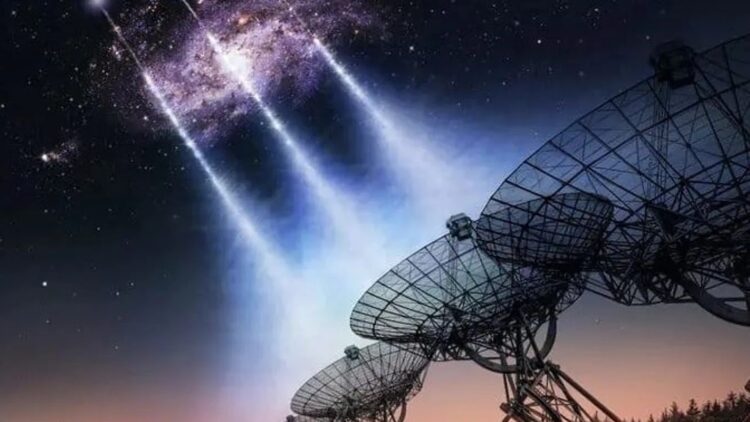
How have they been found? Liam Connor and his team, belonging to the California Institute of Technology have come up with the formula. The rest of the barionic material was found in a cosmological sample of 60 new fast radio bursts taken with the DSA-110 radio telescope.
Rapid radio bursts (FRBs)
They are considered one of the shortest phenomena in the cosmos. These are signals of extragalactic origin that traverse large regions of space in milliseconds. One of its most relevant characteristics is its electromagnetic dispersion when traversing space. This produces a delay in the radio frequencies that collides with the ionized material. This delay has a name: dispersion measurement (DM). The dispersion measurement of each burst has different components: the one caused by the Milky Way, the home galaxy and the ionized gas between them.
Results
For greater reliability, the experiment used different approaches to provide greater accuracy. On the one hand, they launched the model based on Markov chains (MCMC), and on the other hand the fraction of diffuse matter. The latter (fd), the observed dispersion is divided between a cosmological function. Despite being different methods, both revealed that 90% of the baryons were in the state of ionized diffuse gas. In addition, they also match IllustrisTNG and SIMBA and their simulations. The vast majority of this matter is found outside galaxies.
New map of the invisible universe
The usefulness of this study is to have been able to draw a map of all that non-visible bachinic matter, and finally be able to locate it. It is already known to be found in the intergalactic medium (IG), the intracumular medium (ICM), the galactic halos (CGM) and galaxies. Unlike the initial mass function of Salpeter, it has been possible to specify that between 4% and 7% is in the form of stellar matter, compared with 1% in cold gas within galaxies.
Importance of FRBs
The importance of these bursts lies in that, as he explains in a study published in Nature Astronomy, they can be as effective as the cosmic microwave background to now obtain information from the universe. Current as lanterns, illuminating regions that without them would never be visible. Researchers are still digesting the magnitude of this finding, finally having answers to so many questions that had been asked for 25 years. For the future, it is planned to use the Deep Synoptic Array-2000 project. It will be able to detect up to 10,000 FRBs per year, resulting in a much more detailed map.