
Last spring, a sighting occurred in the sky that, at first glance, no one was able to identify. It moved unusually, and its trajectory and brightness varied over time. It was the NASA space probe, Lucy, that took photographs of it, shedding more light on this mystery. It was discovered to be the asteroid Donaldjohanson, about which the lead researcher, Hal Levison, said that this body displayed complex geology.
Every piece of data obtained from the asteroid helps improve planetary formation models and provides a better understanding of the Solar System. The shape of the asteroid confirms that it is a contact binary, resulting from the collision of two smaller bodies 150 million years ago. The most curious thing about all this is that Lucy’s space mission consists of finding Jupiter’s Trojan asteroids. However, these are the surprises the universe gives us.
Lucy, NASA
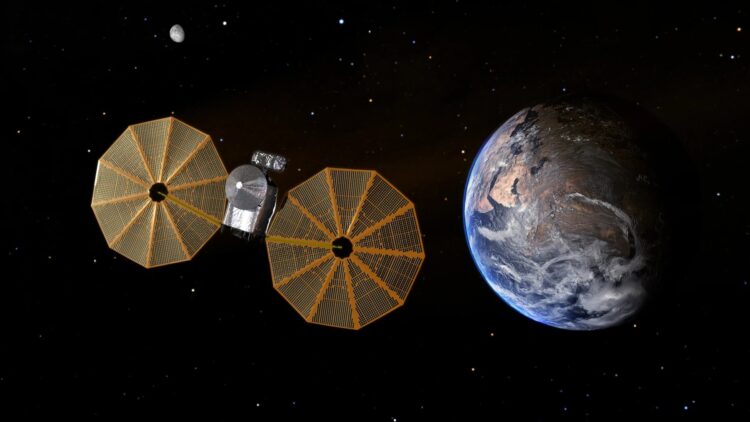
NASA’s mission, Lucy, is a space probe that was launched into space in October 2021. Its mission is to study the Trojan asteroids of Jupiter, as well as the primitive remnants of the solar system, with the goal of achieving a better understanding of planet formation.
New findings from Lucy
Last spring, an unknown object was detected in the sky, approaching Earth. At first, it was unclear whether it was a fragment of an asteroid or remnants of some ancient collision. One of the things that caught attention was the way it moved, as well as its trajectory and brightness, which varied over time. Its nature could not be deciphered until Lucy came into play. It was then that clearer images were finally obtained that could provide some information.
Donaldjohanson asteroid
The object that generated so much doubt turned out to be the asteroid Donaldjohanson. Its appearance was smooth and bright, dotted with craters, especially on the largest lobe, about 8 kilometers long. According to the principal investigator of the Lucy mission, Hal Levison, “The asteroid Donaldjohanson exhibits incredibly complex geology.” As some researchers believed, its shape revealed that it is a contact binary, the result of two smaller bodies that collided 150 million years ago. The discovery has helped scientists gain a better understanding of the origin of the Solar System. The characteristics of the asteroid are:
- Surprising size: about 8 km long and 3.5 km wide.
- Slow rotation: actual rotation period of approximately 10 days; Lucy’s passage gave the impression of a faster rotation.
- Surface detail: crater concentrated in the larger lobe, smooth and clear in the smaller lobe.
- Ancient origins: likely a fragment of a large collision 150 million years ago.
The most interesting thing about this discovery is that it was not part of the plans for the spacecraft. Lucy aims to study the Trojan asteroids of Jupiter, bodies related to the primitive solar system. However, thanks to its technology, this revealing information has been obtained. According to one of the scientists from the Lucy program, Tom Statler, “These first images of Donaldjohanson once again showcase the tremendous capabilities of the Lucy spacecraft as a driver of discovery”.
What´s next for Lucy?
The plan of the Lucy space probe includes continuing its trajectory in the main asteroid belt, which is its primary mission. It is expected that by 2027, specifically in the month of August, there will be an encounter with Eurybates and Keta. These names refer to a Trojan asteroid and its small moon, respectively. Until that time, it will continue studying and analyzing Trojan asteroids.