
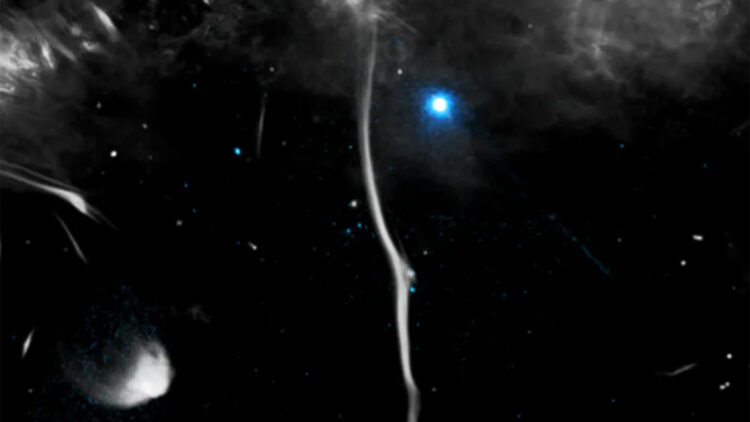
There are mysteries in every galactic body, including ours. Even though astronomers have been studying the sky for centuries, the Milky Way is still full of mystery. Recently, researchers detected a form of fracture in one of the structures that helps define our galaxy.
NASA calls this the “bones of the universe”—long, dense filaments of gas, dust, and rock that extend out the Milky Way’s spiral arms. These cosmic “bones” work like a skeleton, offering scientists indications about where stars, black holes, and even distant planets could live. One of these bones has now been spotted acting unusually, and that finding is pushing scientists to reevaluate how stable our galaxy actually is.
A galactic “bone” that snapped out of line
For years, this specific thread was considered one of the most stable and predictable parts of the Milky Way’s structure.
Then a team of scientists used high-resolution X-ray and infrared telescopes to take a closer look. At first, all they saw were weird, black spots that looked like shadows in space. But when they analyzed the infrared data in the dark, they noticed that there was an apparent break in the filament, as if the structure had been bent or twisted.
The segment is officially called G359.13142-0.20005, but scientists gave it another—more special—nickname: the “Snake.” This Snake is a filament around 230 light-years long, found with the help of NASA’s Chandra X-ray Observatory, a satellite observatory that orbiting Earth and can detect incredibly powerful events in the cosmos.
When the researchers investigated the Snake deeper, they detected evidence of a pulsar. Based on the data, scientists concluded that this pulsar was traveling through the filament at a speed somewhere between 1,609,000 and 3,218,000 kilometers per hour. The galactic bone appears to have been “hit” hard enough by the impact to cause deformation and disruption of its radio signal.
What pulsars can do to the Milky Way’s structure
Pulsars are what’s left of of huge stars that exploded as supernovas; they have very powerful magnetic fields, can spin very quickly, and are extremely dense. These characteristics allow them to emit regular waves of radiation and act almost like massive cosmic lighthouses.
According to the data, the pulsar looked like it interacted with the filament while it was travelling through the Snake. However, scientists noticed that the fracture didn’t look like a simple gap where material had disappeared.
While a part of the filament bends off at an odd, sharp angle, the other part keeps moving following its original axis. The researchers did simulations to see if a collision could actually have caused this. The results confirmed that a galactic filament could be snapped and redirected in this way by a very strong external force, like a fast-moving pulsar.
NASA’s research and observations also suggest that the incident is very recent on cosmic timeframes. The unusual curve, the sharp edge of the fracture, and the uneven density surrounding it show that the Milky Way is still adapting to whatever happened.
Rethinking the “map” of our galaxy
This finding is forcing scientists to reconsider some of their earlier ideas about how the Milky Way is structured and how it keeps together. If one critical component of a cosmic bone can be fractured and bent, then: how many other segments may have been deformed in ways we haven’t discovered yet?
To answer that, astronomers will need to keep employing improved telescopes—especially ones that detect X-rays and infrared light, that can see through the gas and dust that often mask features from regular optical observatories. Mapping other galaxies in similar ways could reveal more cracks, gaps, and bends that were undetectable previously.