
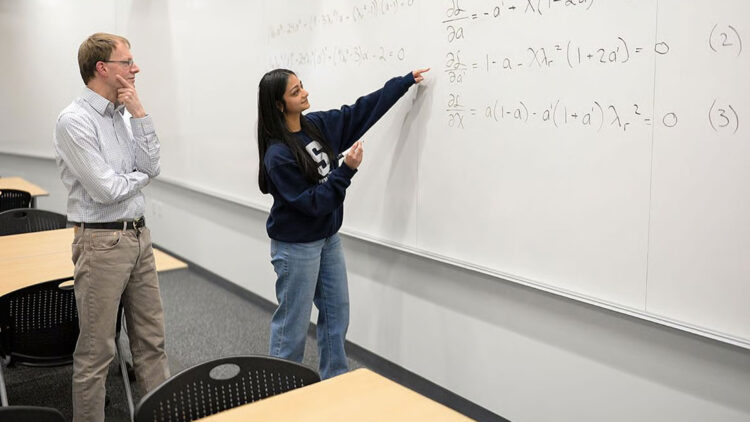
Glauert’s famous math problem, related to wind turbines was somehow there, useful but incomplete, for more than 100 years. This theory, created by a British aerodynamicist worked on how to make better use of the wind with rotors. And helped a lot in designing shovels, but for some modern experts they lacked steps and clarity.
In the Penn State University, in the United Stated, a graduate student, Divya Tyagi, decided to look at the problem again… and found out a new way to resolve it. Her works offers a clearer method for calculating the ideal flow conditions around a wind turbine to get mor energy from the wind.
Her teacher, Sven Schmitz, says that since the beginning, something was off about Glauert’s original approach: “When I thought about the Glauert problem, I thought steps were missing and it was very complicated,” he explains. He suspected that there had to be another way more elegant and straightforward—to solve the problem. “That’s when Divya came in.” “She was the fourth student I challenged with looking at it, and she was the only one who took it on. Her work is truly impressive.”
How Divya improved a problem from a century ago
“I created an addendum to Glauert’s problem which determines the optimal aerodynamic performance of a wind turbine by solving for the ideal flow conditions for a turbine in order to maximize its power output.” Divya explained.
To get there, she used and advanced math tool called calculation of variations, which works to find the “best” possible solution under certain conditions.
His thesis supervisor pointed out a key date that had been little discussed in the original work: “You need to understand how large the total load is, which Glauert did not do.” By including that aspect more completely, Divya’s solution becomes even more useful for engineers who design real turbines, not just for theories on paper.
Why 1% can change a lot
“Improving the power coefficient of a large wind turbine by just 1 percent has significant impacts on the energy production of a turbine, and that translates towards the other coefficients that we derived relations for,” Diva says. And then she add: “A 1 percent improvement in power coefficient could notably increase a turbine’s energy output, potentially powering an entire neighborhood.”
Her teacher believes that Divya’s work will not only stay in scientific articles:“As for Divya’s elegant solution, I think it will find its way into the classrooms, across the country, and around the world,”
The effort behind the discovery and what comes next
To get to this conclusion, it took hours and hours of work. “I would spend about 10 to 15 hours a week between the problem, writing the thesis and on research,” Divya recalls, and she also points that it was a very mathematical intense challenge. “But I feel really proud now, seeing all the work I’ve done.” She adds.
Her thesis received the Anthony E. Wolk Award, to the best aerospace engineering work among his colleagues. In addition, the study was published in the scientific journal Wind Energy Science (WES), which helps other researchers to use and develop their ideas.
Now, Divya is continuing with her postgraduate training, working with computational fluid dynamics simulations. She is also currently studying the air flow around a helicopter rotor in a project supported by the United States Navy, with the goal to improve flight simulation and pilot safety, to give a better understanding how the air behaves in complex situations.
And who knows?… Maybe future student generations could learn from this improved version of Glauert’s problem as the new standard.