
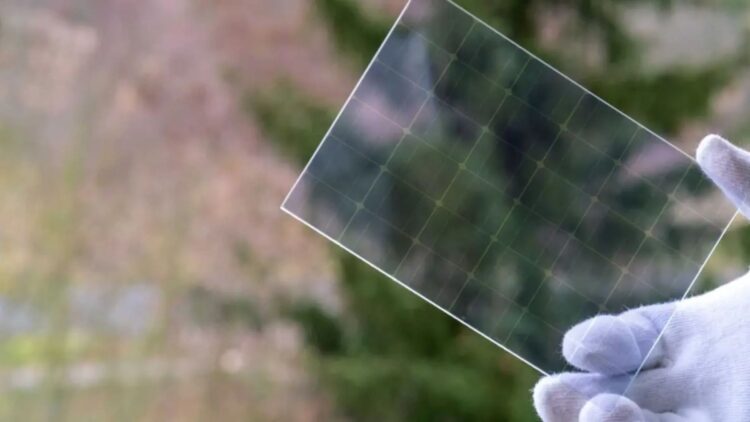
Can you imagine that the light coming through your window not only illuminates your spaces but also generates the energy you need to turn on the television, cook, or have hot water? Well, this concept is no longer a utopia but is becoming a reality thanks to transparent solar panels, known as Smart Glass or transparent photovoltaic glass. Unlike conventional solar panels, which are darker due to the absorption of visible light, transparent solar panels work differently. They absorb what we cannot see: ultraviolet (UV) light and infrared (IR) rays. The technology used in these panels includes special polymers capable of absorbing energy without darkening the glass, and perovskite, which are quantum dots.
This type of technology is being used in areas such as sustainable architecture, where Building Integrated Photovoltaics (BIPV) has become a trend in Europe and the United States. Electric vehicles are also incorporating it, allowing for battery charging even when turned off. More and more smart cities are including this technology in their streetlights, urban panels, or traffic lights. Electronics are not being left behind, launching devices such as glasses or watches that charge without the need for power outlets. However, like all new technology, the main barrier is the cost it entails.
Furthermore, compared to traditional solar panels, the average efficiency remains very low. We also need to consider the durability of perovskite, which, although still being optimized, currently loses a lot of efficiency. We cannot forget the low effectiveness in areas with few hours of sunlight or places where there is always shade. Even with all these drawbacks that still need to be addressed, transparent solar glass allows buildings to generate a large amount or all of the energy needed to avoid dependence on large power plants, similar to what would happen with smart cities and homes.
Transparent solar panels
The possibility of having solar panels in the windows of our homes, without losing a bit of the light that comes through them, is already a reality. Traditional solar panels, the ones we install on facades or roofs, have a dark color due to the absorption of sunlight, which is related to their function. However, glass solar panels operate differently; they absorb ultraviolet (UV) and infrared (IR) radiation. The radiation that we are unable to see is what these glass panels absorb. There are 2 types of transparent solar panels:
- 100% transparent. Less efficiency.
- Semi-transparent. More practical, balance between visibility and energy generation.
Where can they be used?
There are several places where we can find these panels:
- Sustainable architecture. Building-Integrated Photovoltaics (BIPV) is a trend in Europe and the United States, and refers to a building’s ability to be energy self-sufficient.
- Electric vehicles (EV). They allow batteries to be charged even when they are off.
- Smart cities. Those that want to become self-sufficient in clean energy by implementing them in traffic lights, urban panels, or streetlights.
- Electronics. Companies dream of the idea of launching devices that do not require a power outlet to charge, but instead charge with automatic charging sensors.
Disadvantages
One of the main attractions of this technology is that it does not interfere with the design, unlike conventional solar panels. However, not everything can be beautiful. Some of the disadvantages are:
- Its high cost. 100% transparent models cost $400/m2, and semi-transparent ones $80/m2.
- Its efficiency does not match that of traditional solar panels. While these have an efficiency of 20-25%, the transparent models only provide about 7-10%.
- Durability of perovskite. Its durability is still being optimized, but currently, it loses a lot of effectiveness over time and due to humidity.Energy depends on UV and IR radiation.
- In regions with few sunny days or shaded windows, they would not function.
Despite these disadvantages, it is considered one of the best options that combine design and efficiency, in addition to being one of the ways to achieve energy independence in homes, buildings, and cities.
Can you imagine a road that is a solar panel? It’s in Missouri and it’s already working!