
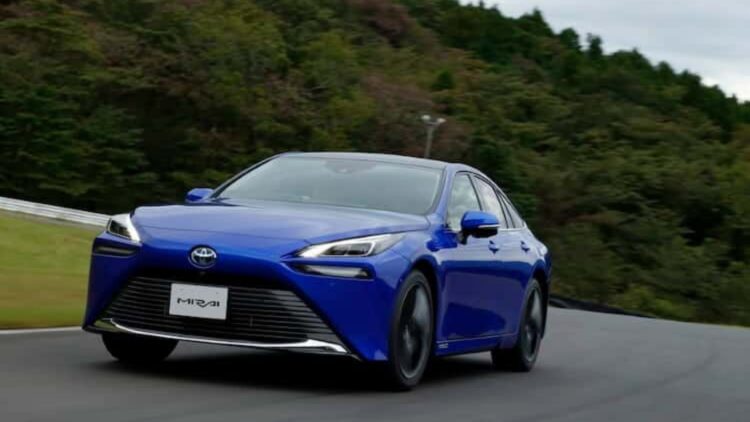
It is not new to read articles about how companies are allocating their resources and efforts to develop an alternative to fossil fuels. In the case of automotive companies, the attempts are even greater. The company Tesla, known for working solely on electric motors, is well-known to all. However, there are other companies like the Japanese Toyota, which is opting for variety and does not want to become stagnant by offering just one alternative. This aligns with their mission called Beyond Zero Vision, whose goal is to achieve carbon neutrality at every stage of production.
One of the alternative solutions that has been pursued is hydrogen fuel cell technology, launching the Toyota Mirai model to the market. In the latest edition of the Hydrogen and Fuel Cells Seminar this year 2025, held in Long Beach, California, Toyota made public its plans to collaborate with other brands in the industry that would otherwise be clear competitors. This is the case with BMW, with whom according to Toyota’s advanced mobility engineer, Jay Sackett, they are collaborating to help develop and implement this technology.
Toyota has also announced that they are working on the development of a four-cylinder model, which will be used in their electrification projects. However, the technology has not yet been implemented in their combustion engines. Toyota is becoming one of the leading companies in the development of technology aimed at sustainable mobility, leaving fossil fuels behind and betting on clean energy.
Innovation and development in sustainable mobility
In the search for the best alternative to fossil fuel engines, many companies have bet everything on electric vehicles. A clear example is Tesla, which was born with the objective of being a leader in this sector, and in addition to having achieved this (for a time), it has also incorporated autonomous driving. In the case of Toyota, they did not want to stop there. They consider it important to offer a variety of sustainable alternatives to consumers, and that mission has been unified under the name Beyond Zero Vision. Through this, they aim to achieve carbon neutrality at all stages of production, not just in the operation of the vehicle. Currently, Toyota has the following offerings:
- Complete electric technology.
- Plug-in hybrid electric vehicles.
- Hydrogen fuel cell technology.
- Hybrid electric vehicles.
Hydrogen fuel-cell technology
This technology is undoubtedly the one that has propelled Toyota in the market for sustainable mobility vehicles. Despite offering more alternatives, and without neglecting electric motor technology, they have strongly bet on this new approach. That is why they have launched a hydrogen fuel cell model to the market, the Toyota Mirai. According to a press release issued by the company, “[The Mirai] – and the millions of miles that have been traveled in the following decade – were just the beginning. Now, Toyota has demonstrated that there are other applications and use cases that can be found with the versatility and scalability of fuel cells”.
Unity is strength
In the latest edition of the Hydrogen and Fuel Cells Seminar 2025, held in Long Beach, California, Toyota made public its intention to collaborate with other companies in the sector that are interested in promoting hydrogen as one of the possible solutions for clean energy. In fact, it is already collaborating with BMW to launch the brand’s first hydrogen-powered vehicle in 2028. According to Jay Sackett, chief engineer of advanced mobility at Toyota, “We are collaborating with companies that would traditionally have been our competitors to develop standards and protocols for hydrogen supply connections, recognizing that an industry standard is more beneficial than our own competitive advantage”.
Looking to the future
Toyota continues to work on launching more innovations, including a new four-cylinder engine with a displacement of between 1.5 and 2.0 liters, primarily intended for electrification projects. However, we will have to wait because the technology has not yet been implemented in its internal combustion engine technology.